
Searching for weed sellers in Sechura can expose you to legal problems, scams, unsafe products, and unnecessary personal risk. This guide does not identify unlicensed sellers or explain how to arrange an illegal purchase. Instead, it explains the legal context in Peru, how to verify legitimate medical pathways, how to recognize warning signs, and what to do if someone approaches you with cannabis for sale.
Rules and enforcement can change, so anyone considering cannabis should confirm current information with Peruvian authorities or a qualified lawyer. Residents and visitors looking for weed in Sechura should treat social-media offers, informal delivery services, and street sales with particular caution.
What to know before looking for cannabis in Sechura
Peru distinguishes between regulated medical and therapeutic cannabis and activity outside the authorized system. That distinction matters. A person who sees a product advertised online should not assume that the seller, product, dosage, or transaction is legal simply because the advertisement uses terms such as “natural,” “medicinal,” or “CBD.”
Unlicensed sales can involve products with unknown strength, contamination, inaccurate labeling, or a different substance altogether. A buyer may also be asked to send money in advance, share identity documents, meet in an isolated location, or accept delivery without any verifiable business information. These are reasons to stop rather than continue the transaction.
For current public-health and regulatory information, consult the Peruvian Ministry of Health and the General Directorate of Medicines, Supplies and Drugs. These official institutions are more reliable than anonymous posts or local chat groups.
Cannabis laws in Sechura: the practical distinction
There is no separate Sechura cannabis market with its own independent licensing system. National Peruvian rules apply in Sechura, just as they do elsewhere in the country. Local availability does not make a product authorized, and the fact that other people discuss a seller does not prove that the seller is operating lawfully.
The safest approach is to separate three questions:
- Is the product permitted? The product must fall within a legally recognized category rather than being an unregulated preparation.
- Is the provider authorized? A legitimate medical route should involve appropriate health professionals and authorized establishments, not only a private messaging account.
- Is the intended use appropriate? Cannabis is not risk-free, and a clinician should assess possible interactions, contraindications, and alternatives.
Do not rely on an online seller’s interpretation of possession, transport, cultivation, or sale rules. If the legal question involves a personal case, a minor, travel, employment, or a prescription, obtain advice from a Peruvian legal professional or the relevant authority.
How to investigate a purported seller without arranging a purchase
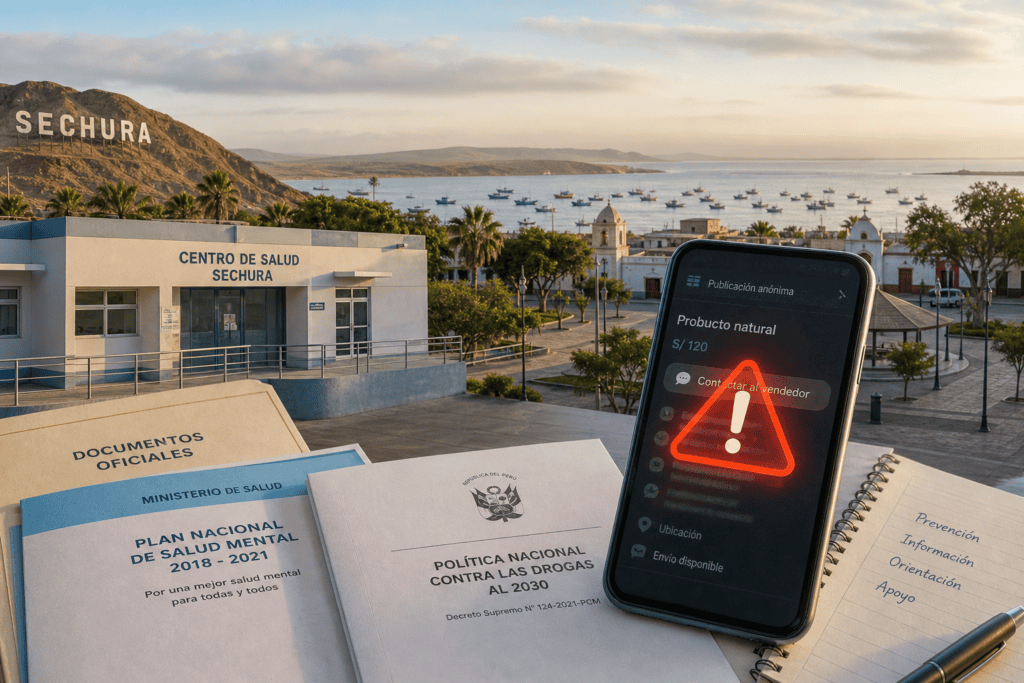
If you encounter an advertisement for cannabis in Sechura, you can assess its credibility without sending money or meeting the seller. Look for verifiable information rather than persuasive claims.
Check for transparent business details
A legitimate health-related business should be able to identify its legal name, physical location, responsible professionals, and authorization status. Be cautious when an account provides only a nickname, disappearing messages, a temporary phone number, or a request to communicate exclusively through encrypted chats.
Search independently for the business rather than using a link supplied by the advertiser. Confirm that the name, address, telephone number, and operating hours match across reliable sources. A polished website or large number of followers is not proof of authorization.
Question unsupported product claims
Be skeptical of promises that a product will cure cancer, anxiety, chronic pain, insomnia, or another condition. A seller who refuses to provide a complete label, ingredient list, batch information, or safety instructions is not offering adequate transparency. Statements about “strongest in Sechura,” “guaranteed pure,” or “no risk” should be treated as marketing, not evidence.
Never pay under pressure
Urgency is a common feature of scams. Walk away if someone demands an advance transfer, asks for cryptocurrency or gift cards, threatens to disclose private messages, or changes the price after agreeing to a transaction. Do not send photographs of identity documents or personal information to an unknown account.
Medical cannabis in Sechura: use a health-led route
People seeking medical cannabis in Sechura should begin with a qualified health professional, especially if they have a heart condition, a history of psychosis, are pregnant, or take medicines that may interact with cannabis. A clinician can discuss whether cannabis is appropriate and whether another treatment has better evidence or a lower risk profile.
A health consultation should cover the reason for use, current medicines, allergies, previous reactions, mental-health history, and practical concerns such as driving or work-related safety. Do not stop prescribed treatment or change a dose because an online seller made a claim.
Ask any purported medical provider where the product comes from, how it is labeled, how its quality is controlled, and what professional supervision is available. If those questions cannot be answered clearly, the service should not be treated as a medical option.
Red flags associated with informal weed sellers
Whether the contact begins at a market, through social media, or in a local messaging group, the following signs indicate that the situation may be unsafe or unlawful:
- No verifiable business identity, address, or responsible professional.
- Claims that the seller can guarantee legal immunity or avoid official controls.
- Pressure to meet alone, enter a private residence, or travel to an unfamiliar area.
- Requests for payment before basic information is provided.
- Products sold in unmarked bags, containers, or reused packaging.
- No ingredients, batch details, warnings, or instructions for use.
- Promises of instant cures or unusually powerful effects.
- Threats, harassment, or demands for personal photographs and documents.
One warning sign may be enough to end the conversation. You do not need to prove that an account is fraudulent before protecting yourself.
Safer steps if someone offers you weed in Sechura
If a stranger or online contact offers cannabis, keep the interaction brief and avoid sharing personal details. Do not carry a package for another person, agree to transport products across districts, or accept an item whose contents you cannot verify. Transport can create additional legal and personal risks, even when someone describes the product as medicinal.
If you have already sent money, preserve receipts, usernames, phone numbers, profile links, and messages. Contact your bank or payment provider quickly to ask whether a transaction can be stopped. For threats or suspected criminal activity, use official reporting channels and avoid confronting the person directly.
When meeting any legitimate health provider, choose a public professional setting, tell someone you trust where you are going, and arrange your own transport. These general precautions do not make an unlicensed cannabis transaction safe; they are relevant only to ordinary healthcare or business appointments.
Alternatives to searching for unlicensed sellers
Many people searching for weed in Sechura are actually looking for relief from pain, sleep difficulties, stress, or another health concern. A primary-care appointment can help identify the underlying problem and provide lawful treatment options. Pharmacies, clinics, and licensed medical professionals can also explain which products are available through recognized channels.
If cost or travel is a barrier, ask a local health service about public options, referrals, telehealth availability, and patient-support programs. Keep written records of symptoms, previous treatments, side effects, and questions for the clinician. This makes a consultation more useful than relying on a seller’s informal recommendation.
Readers comparing information about nearby areas may also find our guides to cannabis discussions and safety concerns in Paita and online cannabis retailer claims in Catacaos useful. These related locations are not substitutes for official legal or medical advice, and the same caution applies to any informal listing.
Questions to ask before trusting any cannabis information
- Is the source an identifiable institution, clinician, or authorized business?
- Does the information explain both possible benefits and risks?
- Can the legal claim be checked against a current official source?
- Does the product have clear labeling and traceable information?
- Is anyone pressuring me to pay, travel, or disclose private details?
If the answer to the first three questions is no, treat the information as unverified. If the answer to the final question is yes, end the interaction and consider reporting it.
Conclusion
Finding weed sellers in Sechura is not simply a matter of locating a nearby contact. Unlicensed sellers can create legal exposure, health risks, fraud, and personal-safety problems. The more responsible route is to verify current Peruvian rules, use qualified medical advice for health concerns, and rely only on authorized channels where available.
For anyone researching cannabis laws in Sechura, the key principle is simple: local availability does not equal legality or safety. Avoid anonymous sellers, never send money under pressure, protect your personal information, and consult official institutions before making decisions.

The Ziklane Editorial Team is dedicated to providing accurate, well-researched, and up-to-date information on cannabis laws and regulations around the world. Our content is created through careful research of publicly available legal sources, government publications, and reputable references to help readers better understand local cannabis legislation. We are committed to delivering educational, factual, and regularly updated content while encouraging readers to comply with the laws of their respective countries and regions.