
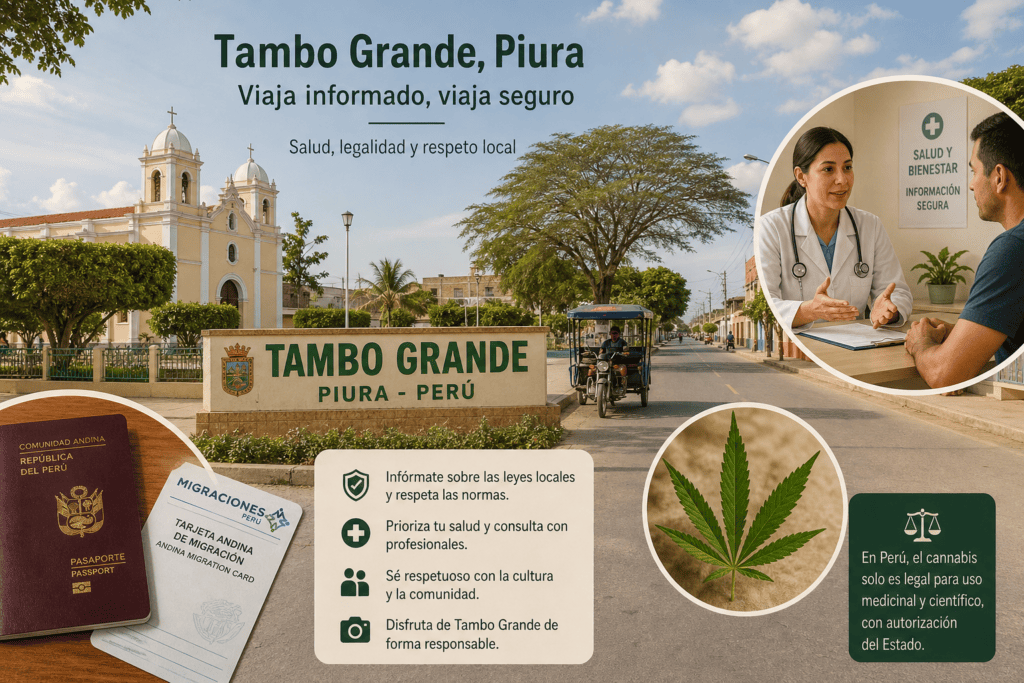
Anyone searching for weed in Tambo Grande should begin with legality, not with a seller or an informal marketplace. Tambo Grande is in the Piura region, and local availability does not change Peru’s national rules on cannabis, possession, cultivation, distribution, or medical use. Because unregulated products can create legal, health, and personal-safety problems, the most responsible approach is to confirm whether your intended use is lawful and obtain cannabis only through an authorized medical route when applicable.
This guide does not identify vendors, arrange purchases, or recommend informal contacts. Instead, it explains how to assess your options, recognize unreliable offers, protect your privacy, and avoid situations that could expose you to criminal charges or contaminated products.
What to know before looking for cannabis in Tambo Grande
Peruvian cannabis rules distinguish between medical use and unauthorized commercial activity. Medical cannabis is regulated, while selling, supplying, transporting, or distributing cannabis outside the applicable legal framework can carry serious consequences. The fact that people may discuss cannabis locally does not mean a particular product or seller is licensed.
Rules can also depend on the type of conduct involved, the quantity, the intended use, and whether the product is connected with sale or distribution. Do not treat informal claims about “personal amounts,” social-media offers, or local custom as legal advice. For current health guidance and official information, consult the Peruvian Ministry of Health and, when necessary, a qualified Peruvian lawyer.
Medical access is the clearest lawful route
If cannabis is being considered for pain, sleep, anxiety, epilepsy, or another health concern, speak with a licensed healthcare professional first. A clinician can assess alternatives, possible interactions, and whether a cannabis-based treatment is appropriate. Medical cannabis in Tambo Grande should be approached through a documented medical process rather than through an anonymous seller.
Ask the health professional what type of product is appropriate, how it should be used, what side effects to monitor, and whether follow-up is required. Do not assume that a product described as “natural,” “CBD,” or “medicinal” is automatically legal, safe, or free from intoxicating THC. Labels can be inaccurate, and imported or homemade products may not meet Peruvian requirements.
Recommendations for purchasing weed in Tambo Grande safely
For adults who may legally access a cannabis-based product, the following recommendations reduce avoidable risks. They are not instructions for finding an illegal seller; they are a checklist for evaluating whether a proposed source is legitimate and whether you should walk away.
- Confirm the legal pathway first. Establish whether your use falls within Peru’s medical framework and what documentation or authorized provider is required.
- Prefer regulated channels. A legitimate provider should be able to explain its authorization, product identity, and basic handling procedures without pressuring you to keep the transaction secret.
- Request clear product information. Packaging should identify the product, ingredients, cannabinoid content, batch or lot information, expiration details, and responsible manufacturer or distributor where required.
- Avoid unsealed or repackaged products. Loose flower, unlabeled oils, homemade edibles, and products transferred into ordinary plastic bags offer no reliable information about potency or contamination.
- Do not rely on price alone. An unusually cheap product may be diluted, misidentified, old, or obtained through an unlawful supply chain. A high price is not proof of quality either.
- Keep the transaction private and low-risk. Do not share identity documents, banking details, home-access information, or intimate photographs with unknown contacts.
- Never carry cannabis across borders. International travel rules can be strict even when a product was obtained legally in one jurisdiction. A prescription or medical explanation may not authorize transport into another country.
How to identify red flags in local cannabis offers
Informal advertisements often use vague language and urgency. A person who refuses to identify the product, changes the price at the last minute, demands advance payment, or insists on meeting in an isolated place creates unnecessary risk. Walk away if the seller proposes using another person’s identity, asks you to transport a package, or says that authorities will not care because the quantity is small.
Other warning signs include dramatic health promises, claims that a product cures serious diseases, no ingredient information, pressure to consume immediately, and attempts to move the conversation between multiple anonymous accounts. These behaviors can indicate fraud, unsafe products, theft, or involvement in a wider criminal operation.
Online listings require extra caution
Search results, messaging groups, and social-media pages are not proof that a business is authorized. Photos can be copied, reviews can be manufactured, and a seller may not be located where the profile claims. Never send money simply because an account displays a logo, a delivery map, or positive comments.
Do not arrange a meeting at your home or agree to a delivery that conceals the contents. If a contact becomes aggressive after you ask basic questions about legality or product labeling, stop responding and preserve relevant messages in case you need to report harassment or fraud.
Product and health checks that matter
Cannabis products vary considerably in potency and effect. Unregulated flower may contain mold, pesticides, or other contaminants, while oils and edibles can have inaccurate cannabinoid concentrations. You cannot reliably judge safety by smell, color, packaging, or a seller’s assurance.
If a lawful product has been recommended by a healthcare professional, follow the product directions and begin cautiously rather than assuming that more will work better. Avoid combining cannabis with alcohol, sedatives, or other intoxicating substances. Cannabis can impair reaction time, attention, and judgment, so do not drive, operate machinery, swim alone, or supervise children while impaired.
People who are pregnant or breastfeeding, under the legal age, prone to psychosis, or taking medications should seek professional advice before using cannabis. Seek urgent medical help for severe confusion, chest pain, trouble breathing, loss of consciousness, or a serious allergic reaction. Keep all cannabis products locked away from children and pets, particularly edibles, which can resemble ordinary food.
Privacy and personal safety in Tambo Grande
Personal safety is as important as product safety. Avoid carrying large amounts of cash, displaying valuable belongings, or telling strangers where you live. Do not involve friends, drivers, delivery workers, or relatives in a transaction unless they knowingly and lawfully consent to their involvement.
If you feel threatened, leave the area and contact local emergency services or the police. Do not confront a suspected scammer or attempt to recover money in person. Save usernames, phone numbers, payment records, and threatening messages, but avoid publishing private information publicly.
Visitors should be particularly careful. A hotel, rented room, or private residence is not a safe place for an unknown person to arrive with an unverified product. Accommodation rules may also prohibit cannabis possession or use, even where a medical pathway applies.
How to verify information about cannabis laws in Tambo Grande
Information about cannabis laws in Tambo Grande should come from current Peruvian authorities rather than old blog posts, anonymous comments, or advice from a seller. Check whether the information concerns medical cannabis, personal possession, cultivation, transport, or commercial distribution; these are not interchangeable categories.
For public-health resources and official announcements, consult the National Commission for Development and Life Without Drugs. If a question involves arrest risk, importing a product, operating a cannabis-related business, or using cannabis while traveling, obtain advice from a licensed Peruvian attorney. Online summaries may omit important exceptions or recent regulatory changes.
Use regional comparisons carefully
Guides about other Peruvian cities can provide general safety reminders, but they do not establish that a seller is active or legal in Tambo Grande. For example, readers may compare the approach described in this article with a legal and safety guide for cannabis-related questions in Chulucanas or a discussion of online cannabis claims in Catacaos. Regional proximity is not a substitute for checking current law and authorization.
Questions to ask before proceeding
Before obtaining any cannabis-based product, ask yourself:
- Is my intended use lawful under Peru’s current rules?
- Have I discussed the risks and alternatives with a qualified healthcare professional if this is for medical use?
- Can I verify the provider and product through a legitimate, documented channel?
- Does the packaging provide enough information to identify the product and its contents?
- Am I being pressured to pay quickly, conceal the transaction, or meet somewhere unsafe?
- Could using or carrying this product affect driving, work, immigration, travel, housing, or family responsibilities?
If the answer to any of these questions is unclear, postponing the purchase is safer than relying on an informal promise. No product is worth exposing yourself to an avoidable legal or health emergency.
Conclusion
The best recommendation for purchasing weed in Tambo Grande is to avoid informal sales and begin with Peru’s legal and medical framework. Confirm the rules, consult an appropriate professional, use only verifiable authorized channels, and reject products with missing labels or suspicious claims. Treat online offers and local introductions as unverified until proven otherwise, protect your personal information, and never drive or mix cannabis with other intoxicants.
Approaching cannabis in Tambo Grande cautiously may not provide the quick answer that an informal advertisement promises, but it greatly reduces the chance of fraud, contamination, injury, or legal trouble. When in doubt, choose reliable official information and professional advice over convenience.

The Ziklane Editorial Team is dedicated to providing accurate, well-researched, and up-to-date information on cannabis laws and regulations around the world. Our content is created through careful research of publicly available legal sources, government publications, and reputable references to help readers better understand local cannabis legislation. We are committed to delivering educational, factual, and regularly updated content while encouraging readers to comply with the laws of their respective countries and regions.