
Finding reliable places to buy weed in Juliaca, Peru requires understanding the difference between regulated medical cannabis and unlicensed recreational sales. Peru does not operate a general recreational cannabis retail market, so visitors and residents should be cautious about social-media offers, street sellers, and informal delivery services that promise cannabis without documentation.
This guide explains the legal route for medical cannabis, how to check whether a product and seller are legitimate, and what to do if you cannot verify a source. It does not identify illegal dealers or provide instructions for evading Peruvian law. Rules and enforcement can change, so confirm current requirements with official Peruvian health authorities before purchasing or carrying any cannabis product.
Understanding cannabis laws in Juliaca
Juliaca follows Peru’s national legal framework. Local businesses cannot simply open a recreational dispensary because a product is advertised online or sold in a market. The legal position depends on the product, its intended medical use, the authorization of the business, and the documentation supporting the transaction.
Peru has a regulated framework for medicinal and therapeutic cannabis. That framework should not be interpreted as permission to buy ordinary recreational marijuana from an informal seller. Possession, transport, cultivation, sale, and importation may involve different legal questions, and the details can depend on quantity, purpose, authorization, and circumstances.
For current public-health information, consult the Peruvian Ministry of Health. For medicine-registration and pharmaceutical-regulatory information, the General Directorate of Medicines, Supplies and Drugs is a more appropriate starting point than social media or anonymous forums.
Where medical cannabis may be available in Juliaca
People searching for medical cannabis in Juliaca should begin with a healthcare professional and an authorized pharmaceutical channel rather than a private seller. A clinician can determine whether cannabis-based treatment is medically appropriate and explain what type of product, formulation, and follow-up may be needed.
Authorized pharmacies and regulated products
Some cannabis-based medicines may be supplied through authorized pharmaceutical establishments, depending on the product’s registration and the applicable prescription or documentation requirements. Availability in Juliaca may be more limited than in larger Peruvian cities, so a pharmacy may need to confirm stock or explain whether a lawful order can be fulfilled.
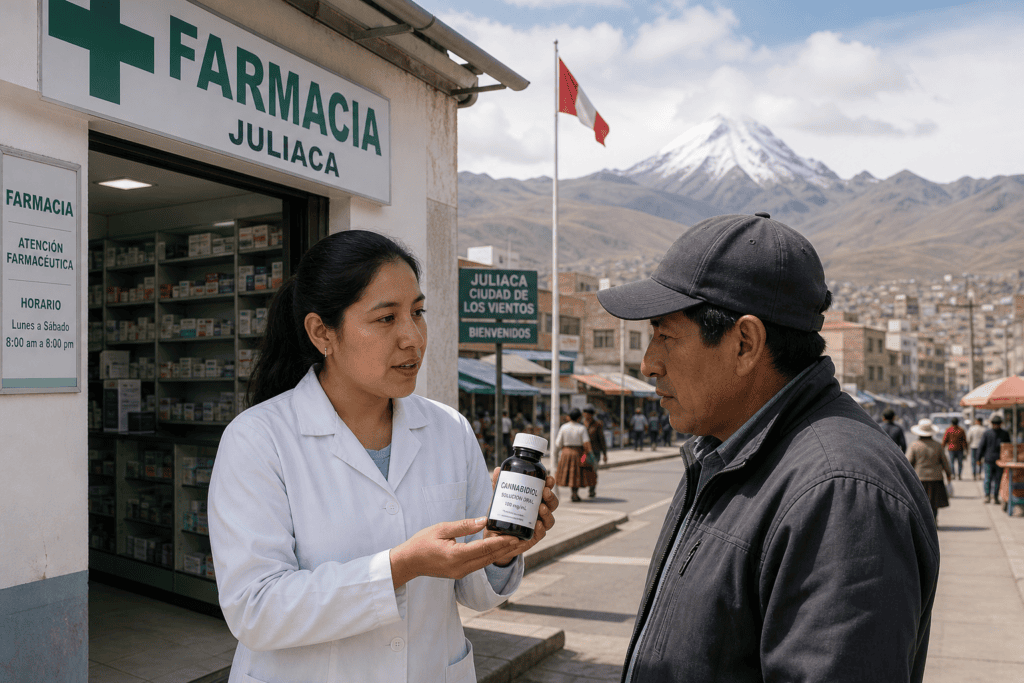
Before paying, ask the establishment to identify the product’s manufacturer, registration or authorization details, concentration, batch information, expiration date, and instructions for use. A legitimate pharmacy should be able to provide clear information about the medicine and issue a receipt. If staff refuse to identify the product or insist on cash-only arrangements without documentation, treat that as a serious warning sign.
Medical consultation and referral
A local doctor, specialist, or licensed clinic can help distinguish a regulated cannabis medicine from an untested extract or plant material. This is especially important for people taking sedatives, antidepressants, seizure medicines, anticoagulants, or other prescription drugs, because cannabis products may create risks or interactions.
When contacting a clinic, ask whether the professional is authorized to practice in Peru and whether the consultation includes follow-up. Be cautious of websites that guarantee approval, promise a particular strain, or sell medicine as part of a consultation without a proper clinical assessment.
How to assess cannabis offers in Juliaca
Search results for weed in Juliaca may include informal listings, messaging-app accounts, or advertisements using medical language without proof of authorization. An attractive price or professional-looking logo does not establish that a seller is legal or that the product is safe.
- Check the business identity: Look for a real business name, physical address, telephone number, and a formal receipt.
- Ask about authorization: The seller should be able to explain which authority regulates the establishment and product.
- Inspect the packaging: Sealed packaging should show a product name, ingredients, concentration, batch or lot number, expiration date, and manufacturer details where applicable.
- Request clear instructions: A regulated medicine should include dosage and storage information appropriate to its formulation.
- Reject unverifiable claims: Promises to cure cancer, anxiety, epilepsy, or every other condition are not a substitute for clinical evidence.
- Keep documentation: Save receipts, prescriptions, product photographs, and written instructions in case you need to verify the purchase or report a problem.
Red flags when looking for cannabis in Juliaca
Informal cannabis sales can expose buyers to legal, financial, and health risks. A seller may misrepresent the strength or contents of a product, and there is usually no reliable way to confirm contamination, pesticides, solvents, heavy metals, or the actual amount of THC and CBD.
Be especially wary when an offer involves meeting at an isolated location, sending money before seeing the product, using cryptocurrency or gift cards, avoiding all written records, or asking you to transport a package across a border. Do not allow anyone to use your luggage, vehicle, address, or bank account for cannabis-related activity.
Other warning signs include unlabeled oils, homemade edibles, products supplied in ordinary plastic bags, claims of guaranteed delivery, and sellers who pressure you to purchase immediately. A product described as “medical” is not necessarily a legally authorized medicine.
Buying cannabis safely as a visitor
Travelers should not assume that rules from Canada, the United States, Spain, or another country apply in Peru. A valid foreign prescription may not automatically authorize purchase, possession, or importation. Carrying cannabis across an international border can create separate customs and criminal-law risks even when the product was legally obtained elsewhere.
Do not bring flower, oils, edibles, cartridges, or prescription cannabis into Peru without confirming the requirements with the relevant Peruvian authorities and your airline. Avoid accepting packages from strangers or transporting cannabis for another person. If you are visiting Juliaca for a short period and require a prescribed medicine, ask your treating clinician and the appropriate Peruvian health authority about lawful documentation before traveling.
What to do if Juliaca has limited legal availability
Limited local availability does not make an informal seller a safe substitute. Ask an authorized pharmacy whether it can lawfully order a registered product, whether another regulated establishment can dispense it, or whether a healthcare professional can recommend an approved alternative. Do not place an online order until you have verified the seller’s authorization, product status, delivery terms, and documentation.
Readers comparing information about cannabis access in other Peruvian cities can also review our guides to legal and safer cannabis questions in Tacna and cannabis access considerations in Lima. These articles should be treated as general reading, not as proof that a particular seller is licensed or currently operating.
Health and responsible-use considerations
Cannabis can affect attention, reaction time, memory, coordination, mood, and heart rate. Avoid driving or operating machinery after using a cannabis product. Combining cannabis with alcohol, sedatives, or other psychoactive substances can increase impairment and other risks.
Extra caution is appropriate for adolescents, pregnant or breastfeeding people, individuals with a history of psychosis or severe anxiety, and people with heart or respiratory conditions. Keep medicines away from children and pets. Edibles can take longer to produce effects, making accidental overconsumption more likely; never take more simply because the initial effect feels delayed.
If someone experiences severe confusion, chest pain, difficulty breathing, a seizure, loss of consciousness, or extreme agitation after using cannabis, seek emergency medical help. Bring the product packaging if it is available, and tell medical personnel what was taken and approximately when.
A practical checklist before any purchase
- Confirm whether your intended use is medical and discuss it with a qualified clinician.
- Check the current Peruvian rules through official health and pharmaceutical authorities.
- Use an identifiable, authorized pharmaceutical establishment whenever lawful access is available.
- Verify labeling, registration information, batch details, expiry date, and receipt.
- Do not buy products that are unlabeled, aggressively marketed, or impossible to trace.
- Do not carry cannabis across borders or transport it for another person without verified legal authorization.
- Store any medicine securely and follow professional instructions rather than online dosing advice.
Conclusion
The safest answer to the question of places to buy weed in Juliaca, Peru is not a list of informal vendors. Juliaca is subject to Peru’s national cannabis rules, and lawful access is centered on regulated medical products, qualified healthcare advice, and authorized pharmaceutical channels. Verify every seller and product through official sources, avoid untraceable offers, and obtain professional guidance before using cannabis for a health condition. When legal status or product authenticity cannot be confirmed, the safest choice is not to buy it.

The Ziklane Editorial Team is dedicated to providing accurate, well-researched, and up-to-date information on cannabis laws and regulations around the world. Our content is created through careful research of publicly available legal sources, government publications, and reputable references to help readers better understand local cannabis legislation. We are committed to delivering educational, factual, and regularly updated content while encouraging readers to comply with the laws of their respective countries and regions.