
If you are searching for a weed buying guide Chiclayo Peru, the most important point is to understand that cannabis access in Peru is primarily a regulated medical issue, not a broad recreational retail market. That makes source verification, medical advice, and current legal information more important than price or convenience.
This guide explains how to approach weed in Chiclayo responsibly. It does not identify informal sellers or provide instructions for purchasing prohibited cannabis. Instead, it focuses on lawful medical access, product checks, questions to ask, and warning signs that can help residents and visitors avoid unsafe or fraudulent transactions.
What to know about cannabis laws in Chiclayo
Chiclayo follows Peru’s national cannabis rules. Local shops, social-media accounts, delivery services, or private sellers cannot create their own legal market. Before looking for a product, check the current information from the Peruvian Ministry of Health and confirm whether the product and seller fit the applicable medical regulations.
In practical terms, people should distinguish between medical cannabis obtained through an authorized channel and cannabis offered informally for recreational use. A listing that promises anonymous delivery, unusually low prices, no questions about health, or guaranteed effects should not be treated as proof of legality. Laws and administrative requirements can change, so a current government source is more reliable than an old social-media post or forum comment.
For a broader comparison of how location-specific cannabis questions should be approached in Peru, see this legal and safer guide to weed retailers in Trujillo. The same principle applies in Chiclayo: verify the legal basis first, then evaluate the product and provider.
Medical cannabis in Chiclayo: start with professional advice
If your purpose is symptom management, begin with a qualified healthcare professional rather than a seller. Cannabis may interact with medicines, affect alertness, and be unsuitable for some people. A clinician can discuss whether it is appropriate, what outcome is being considered, and how to monitor unwanted effects.
Questions to discuss with a clinician
- What condition or symptom is being treated?
- Are there non-cannabis treatments that should be tried or continued?
- Could cannabis interact with current medicines or alcohol?
- What side effects should prompt a call to a healthcare professional?
- How should treatment progress be assessed rather than judged by a seller’s claims?
A medical consultation does not mean every cannabis product is suitable. It is still necessary to verify the product’s formulation, labeling, origin, and instructions. Avoid replacing prescribed treatment or changing medication without professional guidance.
How to evaluate a legal cannabis provider
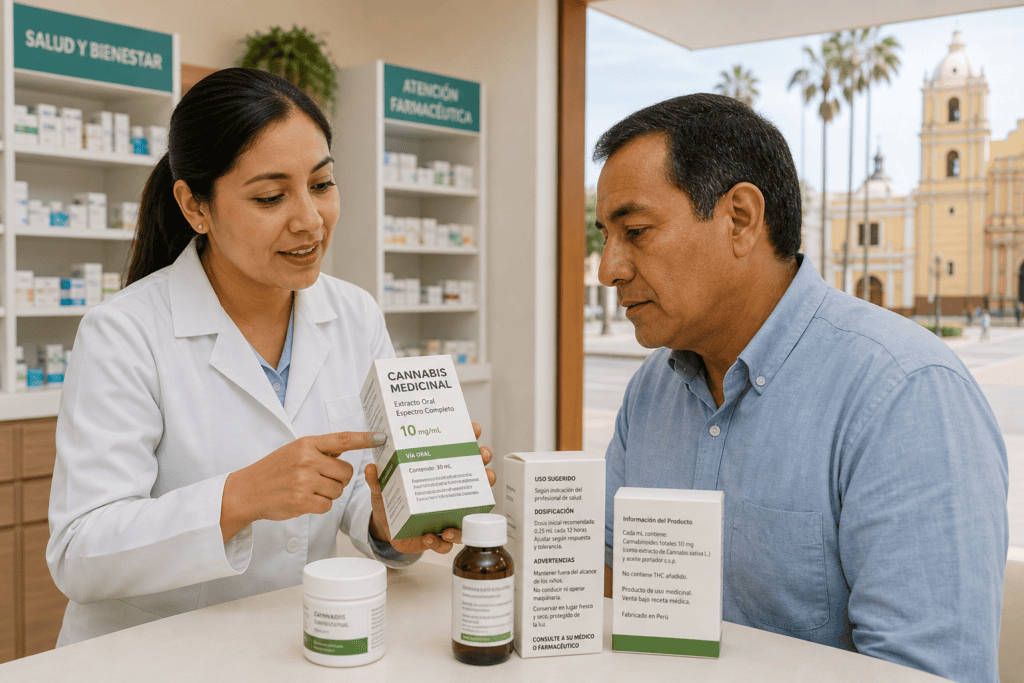
When researching cannabis in Chiclayo, prioritize providers that can clearly explain their legal status and product documentation. A responsible provider should be willing to answer basic questions without pressuring you to pay immediately.
Useful checks before purchasing
- Business identity: Ask for the formal name of the pharmacy, distributor, or company and verify that its details are consistent across its website, receipt, packaging, and customer service channels.
- Medical requirements: Ask what prescription, registration, or other documentation is required for the product. A seller who says that no health information is ever needed deserves extra caution.
- Product labeling: Look for the product name, ingredients, cannabinoid information, batch or lot number, expiration date, manufacturer, and storage instructions where applicable.
- Traceability: Ask whether the product came through an authorized supply chain and whether documentation can be provided. Do not rely on a photograph of a label alone.
- Receipt and support: A legitimate transaction should provide a receipt or other purchase record and a way to ask about adverse reactions, returns, or product concerns.
These checks do not guarantee that a product is effective, but they help separate accountable providers from anonymous sellers. Be especially cautious when a seller refuses to disclose ingredients or uses medical claims that sound absolute, such as promising to cure serious diseases.
Product quality and labeling: what to look for
Appearance is not a reliable quality test. Color, smell, texture, and attractive packaging cannot confirm potency, contamination status, or accurate cannabinoid content. A product that looks professional may still be mislabeled, while a plain package may not provide enough information to establish safety.
For oils, capsules, or other formulated products, check the concentration and serving information carefully. For dried flower, ask how the product is labeled and stored, but do not assume that a stated percentage is accurate without credible documentation. Avoid products with missing ingredients, broken seals, handwritten potency claims, or unclear expiration dates.
Do not consume products that have visible mold, unusual contamination, leaking containers, damaged seals, or a chemical odor. If a product causes severe confusion, chest pain, difficulty breathing, loss of consciousness, or another urgent reaction, seek emergency medical help immediately.
Prices, payments, and delivery warnings
Price comparisons can be misleading because products may differ in formulation, concentration, packaging, and legal status. The cheapest option may have no traceability, while the most expensive option is not automatically better. Compare like with like and ask what is included in the price.
Payment behavior is one useful warning sign. Be careful with accounts that demand full payment through an untraceable method, change the price at the last moment, or use urgency to prevent questions. A request for identity documents, bank details, or an advance payment should be handled only through a provider whose identity and legitimacy you have independently checked.
Delivery also requires caution. Do not arrange discreet handoffs with unknown people, invite strangers to private accommodation, or carry an unverified substance across borders or into airports. Visitors should remember that rules may differ between Peru and their home country, and transporting cannabis internationally can create serious legal problems even when a product was obtained for medical reasons.
Common red flags when looking for weed in Chiclayo
- Claims that cannabis is completely legal for every purpose.
- No identifiable business, address, receipt, or customer-service channel.
- Promises to cure cancer, anxiety, chronic pain, or other conditions without medical evidence or qualification.
- Products sold without ingredients, batch details, expiration information, or usage instructions.
- Pressure to move a conversation to a private chat and pay immediately.
- Requests to misrepresent a product to customs, police, a courier, or a healthcare professional.
- Offers to sell products to minors or to people who have not been medically assessed.
One red flag alone may not prove misconduct, but several together are a strong reason to stop. Do not attempt to test an unknown product by taking a larger amount, mixing it with alcohol, or combining it with other drugs.
Safer-use considerations
People who use cannabis under medical guidance should follow the product instructions and keep it away from children and pets. Do not drive, operate machinery, or perform safety-sensitive work if the product affects alertness, coordination, judgment, or reaction time. Avoid sharing prescribed or medically supplied products with other people.
Be cautious about combining cannabis with alcohol, sedatives, or medicines that cause drowsiness. People who are pregnant, breastfeeding, underage, or have a history of serious mental-health or cardiovascular problems should obtain specific medical advice before considering cannabis. These circumstances do not call for informal recommendations from a seller.
How to research cannabis in Chiclayo without relying on rumors
Search results and online discussions can help you discover questions to ask, but they are not proof that a provider is authorized or that a product is safe. Treat anonymous reviews, influencer posts, and forum recommendations as unverified. Check the date of any information and look for confirmation from official health or regulatory sources.
A useful research process is simple: define the medical purpose, consult a healthcare professional, identify the applicable Peruvian requirements, verify the provider, inspect the product information, and keep a record of the purchase. If any step cannot be completed, pause rather than accepting a substitute from an informal seller.
Readers comparing city-specific guidance can also review this safer overview of weed vendors in Lima, while remembering that an article about another city does not replace current national or local verification.
Final recommendations for buying cannabis responsibly
The safest recommendation for weed buying guide Chiclayo Peru readers is to avoid anonymous recreational sellers and focus on lawful medical channels. Confirm the current rules, speak with a qualified clinician, and choose only providers that can explain their identity, documentation, labeling, and support process.
There is no reliable shortcut around verification. A professional-looking advertisement, a low price, or a personal recommendation cannot establish legality or quality. If a seller discourages questions, promises guaranteed medical results, or asks you to bypass official requirements, walk away. In Chiclayo, careful research and responsible medical guidance are more valuable than fast access to an unknown product.

The Ziklane Editorial Team is dedicated to providing accurate, well-researched, and up-to-date information on cannabis laws and regulations around the world. Our content is created through careful research of publicly available legal sources, government publications, and reputable references to help readers better understand local cannabis legislation. We are committed to delivering educational, factual, and regularly updated content while encouraging readers to comply with the laws of their respective countries and regions.