
Finding weed in Langenthal requires more than choosing the nearest product or responding to an online advert. In Switzerland, the legal position depends on the product’s THC content, its intended use and, in some cases, whether it is supplied through an authorised medical or pilot-programme channel. A careful buyer should therefore begin with the rules, not with a seller.
This guide focuses on lawful, safer purchasing decisions in Langenthal and the surrounding Oberaargau area. It explains how to distinguish CBD products from prohibited cannabis, what to check before paying, how medical access works and which warning signs suggest that a listing or product should be avoided. It does not provide instructions for obtaining illegal cannabis.
Understand the rules before buying cannabis in Langenthal
For most adult consumers, the key distinction is THC concentration. Cannabis products containing less than 1% THC are generally treated differently from cannabis with a higher THC level, although additional rules can apply depending on whether the product is sold as a food, cosmetic, smoking product or another category. Cannabis with 1% THC or more is generally prohibited for non-authorised recreational sale and possession under Swiss law.
That does not mean every product labelled “CBD” is automatically suitable or legal. Labels can be inaccurate, and a product may contain more THC than stated. Product format also matters: oils, flowers, vapes, edibles and cosmetics can fall under different regulatory requirements. Before purchasing, check the latest guidance from the Swiss Federal Office of Public Health information on medical cannabis and confirm any specific question with a qualified Swiss authority or professional.
What the THC threshold means
The 1% threshold is an important starting point, but it is not a complete shopping rule. A product marketed as low-THC should have clear labelling, a traceable producer and reliable test information. If the packaging does not identify the THC content, batch or responsible business, treat that absence as a serious warning.
Do not assume that “hemp,” “CBD,” “light cannabis” or “natural” means risk-free. These terms may describe a product category or marketing position, but they do not replace a proper ingredient list and compliance information. Products imported from another country may also have been legal where purchased but not legal to possess or bring into Switzerland.
How to evaluate legal CBD products in Langenthal
For people looking for non-intoxicating products, lawful CBD may be the most relevant category. When comparing CBD products in Langenthal, focus on transparency and product quality rather than the strongest marketing claims. A responsible retailer should be able to explain the product type, its THC content, ingredients, recommended use and the identity of the manufacturer or importer.
Use this buyer’s checklist
- Check the label: Look for CBD and THC amounts, ingredients, net quantity, batch information and the name of the responsible business.
- Ask about testing: Prefer products supported by recent, independent laboratory analysis that identifies cannabinoids and screens for contaminants.
- Inspect the packaging: Avoid damaged, unsealed or improvised packaging, particularly for oils, vapes and edible products.
- Review the product category: A flower, vape liquid, food supplement and cosmetic may be subject to different requirements.
- Be cautious with medical claims: A shop should not promise to diagnose, cure or treat a disease without an appropriate medical basis.
- Keep the receipt: A receipt makes it easier to identify the seller and resolve a problem if the product is defective or mislabelled.
Price alone is not a reliable quality indicator. An unusually cheap product may be old, diluted, contaminated or falsely labelled, while an expensive product is not necessarily better. Compare the information available for each item and choose the seller that gives clear, verifiable answers.
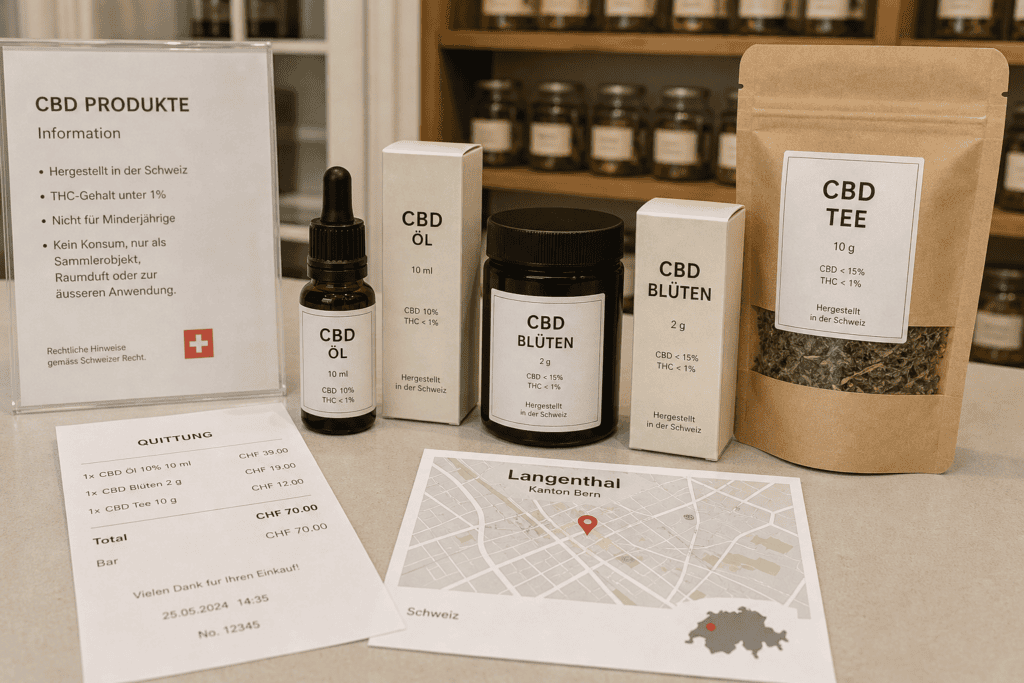
Where to look for cannabis products legally
People searching for cannabis in Langenthal may encounter specialist CBD shops, selected health retailers and online stores serving Switzerland. The important question is not whether a seller appears in search results, but whether the seller provides enough information to establish what is being sold and who is responsible for it.
A physical shop offers one practical advantage: you can inspect packaging and ask questions before paying. However, a local storefront is not proof that every product on its shelves complies with Swiss rules. Online shops can also be legitimate, but buyers should verify the company’s Swiss contact details, terms, returns process, privacy information and product documentation before ordering.
Be particularly careful with social-media accounts, encrypted messaging offers and informal delivery services. A seller who avoids invoices, refuses to identify the product’s THC level or insists on payment methods that provide no transaction record creates unnecessary legal and safety risks. Do not purchase from a source that cannot explain the product’s origin.
Questions worth asking a retailer
- What is the exact THC content, and how was it tested?
- Can I see the ingredient list and batch or lot number?
- Who manufactures or imports the product?
- Is this item intended as a food, cosmetic, smoking product or another category?
- What storage conditions and expiry information apply?
- What is the procedure if the packaging is damaged or the product causes a reaction?
A reputable retailer may not be able to answer every technical question immediately, but should be willing to provide reliable documentation or direct you to the responsible manufacturer. Evasive answers are a reason to leave the transaction.
Medical cannabis in Langenthal: use the healthcare route
Medical cannabis in Langenthal should be discussed with a doctor rather than purchased through an informal seller. Cannabis-based medicines may be appropriate in limited clinical circumstances, but suitability depends on the condition, other medicines, mental-health history, age, pregnancy status and possible side effects. A healthcare professional can also explain dosage, interactions and follow-up.
Do not use CBD oil or high-THC products as a substitute for prescribed treatment without speaking to a clinician. CBD can interact with medicines, and cannabis products may cause drowsiness, impaired attention, dizziness or other unwanted effects. Extra care is important for people taking sedatives, medicines affecting the liver or drugs with a narrow therapeutic range.
The legal route for a medical product is different from buying a wellness item in a shop. Ask the prescriber or pharmacist which products are authorised and how they should be obtained. The Swissmedic official information portal is also a useful starting point for understanding the role of medicines regulation, although individual treatment decisions belong with a healthcare professional.
Safety considerations after purchasing
Even a lawful CBD product deserves sensible handling. Follow the label, store it away from children and pets, and do not drive or operate machinery if you feel impaired. Avoid mixing cannabis products with alcohol or sedating medicines unless a medical professional has specifically advised you. Stop using a product and seek medical advice if you experience severe anxiety, confusion, breathing problems, allergic symptoms or persistent vomiting.
Edibles deserve particular caution because effects can take longer to appear than with inhaled products. Taking more because the first effect is delayed can increase the risk of an unpleasant reaction. Vapes and inhaled products also carry distinct respiratory concerns, especially when ingredients or manufacturing standards are unclear. A product with a complete ingredient list and traceable testing is preferable to an anonymous cartridge or homemade preparation.
Warning signs when buying weed in Langenthal
Some warning signs apply to both online and physical purchases. Treat the following claims or behaviours as reasons to avoid a seller:
- Promises of guaranteed intoxication, guaranteed medical results or instant cures.
- No clear THC information or a label that contradicts the seller’s description.
- Missing manufacturer, importer, batch number or expiry information.
- Pressure to pay quickly or to communicate only through private messaging.
- Products packaged in unlabelled bags, ordinary sweets or reused containers.
- Claims that Swiss law does not apply because the product is “hemp” or “natural.”
- Advice to conceal the product, misrepresent it at the border or use it in public where prohibited.
These signs do not prove that a product is illegal, but they indicate that the seller is not giving you enough information to make a responsible decision. Walking away is usually safer than trying to resolve uncertainty after payment.
Local practicalities and responsible use
Langenthal is a town rather than a separate cannabis jurisdiction, so national Swiss rules remain the foundation. Local rules can still affect where smoking or vaping is permitted, especially around stations, schools, workplaces, public buildings and events. Property owners and businesses may impose stricter no-smoking policies than the general law.
Respect other people when using any cannabis-related product. Avoid use around children, in crowded areas and near people who may be sensitive to smoke or vapour. Never drive after using an intoxicating product. If you are visiting Langenthal, remember that taking cannabis across national borders can create additional legal problems even when the product was purchased lawfully in Switzerland.
A simple decision process for buyers
A sensible purchasing decision can be made in five steps. First, decide whether you are looking for a lawful low-THC product or medical advice; do not blur those purposes. Second, check the current Swiss rules and the product category. Third, compare retailers based on documentation and traceability rather than advertising. Fourth, inspect the packaging and keep your receipt. Finally, use the product only as labelled and seek professional advice if it is intended for a health problem.
This process may take longer than buying from an informal source, but it reduces the chance of receiving a mislabelled, contaminated or unsuitable product. It also gives you a clear point of contact if something goes wrong.
Conclusion
Recommendations for purchasing weed in Langenthal begin with legality, product transparency and personal safety. For most consumers, that means checking whether a CBD product falls within Swiss requirements, choosing a retailer that can provide traceable information and avoiding anonymous or high-pressure offers. Anyone seeking therapeutic effects should use the medical route and discuss risks with a doctor or pharmacist.
Rules and product requirements can change, so confirm current information before buying. A seller’s willingness to explain THC content, testing, ingredients and responsible use is one of the clearest signs that you are making a better-informed choice.

The Ziklane Editorial Team is dedicated to providing accurate, well-researched, and up-to-date information on cannabis laws and regulations around the world. Our content is created through careful research of publicly available legal sources, government publications, and reputable references to help readers better understand local cannabis legislation. We are committed to delivering educational, factual, and regularly updated content while encouraging readers to comply with the laws of their respective countries and regions.