
Finding trustworthy retailers for purchasing weed in Celendín, Peru requires more than locating a social-media account or accepting a recommendation from a stranger. Peru treats cannabis access primarily as a regulated medical issue, so buyers should confirm the legal route, product authorization, prescription requirements, and the identity of any pharmacy or provider before paying.
Celendín is a smaller city in the Cajamarca region, and a local shop that openly advertises cannabis may not necessarily be licensed to sell it. This guide explains how to research weed in Celendín safely without presenting unverified sellers as legitimate. It also outlines what to do if a licensed option is not available inside the city.
What the law means for cannabis in Celendín
Peru has established a medical-cannabis framework, but that does not mean recreational cannabis is sold through ordinary retail channels. Legal access depends on the product, the establishment, the medical indication, and the applicable authorization. The rules can also change, so current information should be checked with official institutions rather than relying on an old blog post, marketplace listing, or online comment.
The Peruvian Ministry of Health is a useful starting point for public-health information and official guidance. The General Directorate of Medicines, Supplies and Drugs is also relevant when checking medicines, pharmaceutical establishments, and regulatory information.
In practical terms, a person looking for medical cannabis in Celendín should expect a more formal process than buying an ordinary consumer product. Depending on the product and current rules, this may involve a medical consultation, a prescription or other documentation, and purchase through an authorized pharmaceutical channel.
How to identify trustworthy retailers for purchasing weed in Celendín, Peru
There may be limited or no officially listed cannabis retailers within Celendín at a given time. For that reason, the safest approach is to verify the business first and only then discuss availability. A legitimate provider should be able to explain its legal status without pressuring you to pay immediately.
1. Look for a verifiable pharmaceutical establishment
A serious seller should provide a real business name, physical address, contact details, and information about the establishment responsible for the sale. Ask whether the business is a pharmacy or another authorized pharmaceutical provider, and request the information needed to verify it with the relevant health authority.
Be cautious when a seller operates only through an anonymous messaging account. An online presence is not proof of authorization. Photos of packages, screenshots of customer messages, and claims such as “imported” or “premium” do not establish that a product is legal or accurately labeled.
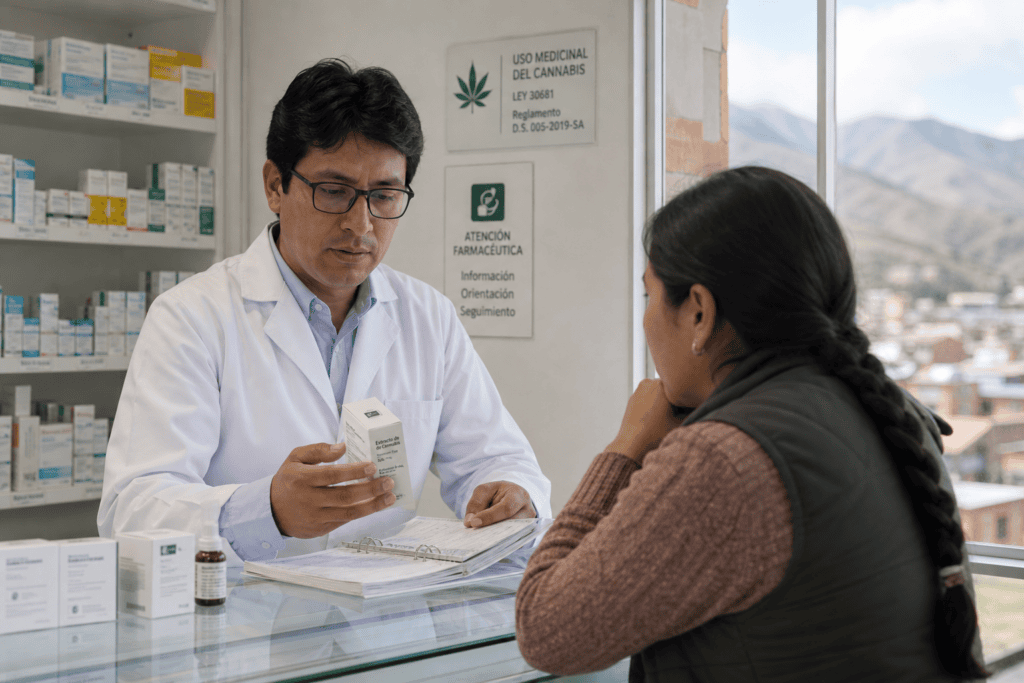
2. Confirm the prescription and consultation process
A trustworthy medical-cannabis provider should not encourage a buyer to bypass medical advice. Ask how a consultation is arranged, which clinician evaluates the patient, and what documentation is required. A seller that promises cannabis for every condition, guarantees a cure, or discourages contact with a doctor should be treated as unsafe.
Do not send a prescription belonging to another person, use altered documents, or provide sensitive medical information to an unknown account. If you are seeking cannabis for pain, epilepsy, sleep problems, anxiety, or another condition, discuss evidence-based options with a licensed health professional before making a purchase.
3. Request clear product information
Packaging should identify the product, manufacturer or responsible company, batch information, contents, and expiration date where required. The label should make clear whether the product contains cannabidiol, tetrahydrocannabinol, or another formulation. Avoid products in unmarked bags, reused containers, or packaging with contradictory information.
Ask whether the product has quality documentation and how it was stored. A credible provider should be able to explain storage conditions and provide instructions that are consistent with the label. If a seller refuses to identify the product or will not discuss basic safety information, walk away.
Red flags when searching for weed in Celendín
Search results and social networks can mix legal medical providers with unlicensed sellers. The following warning signs do not prove a criminal offense, but they are strong reasons not to proceed:
- Promises of recreational cannabis with no prescription or eligibility requirements.
- Pressure to pay a deposit before the business identity and product are verified.
- Requests for cryptocurrency, gift cards, or transfers to unrelated personal accounts.
- No physical address, no business registration details, or a phone number that changes frequently.
- Products described only by informal names, colors, or claimed strength.
- Medical claims that a product cures cancer, replaces prescribed treatment, or works for everyone.
- Delivery arrangements that conceal the product, recipient, or seller and provide no receipt.
- Requests for unnecessary copies of identity documents, banking details, or private medical records.
These risks are especially important in a smaller market. A seller may use the name of a pharmacy without authorization, copy photographs from a legitimate company, or claim to deliver from another city. Verify the actual business independently instead of relying on a link supplied by the seller.
How to compare cannabis providers safely
Once a provider appears legitimate, compare it on transparency and patient support rather than price alone. A low price may reflect missing documentation, poor storage, an incorrect formulation, or an unregulated supply chain.
- Check authorization: Ask which institution regulates the establishment and how its status can be confirmed.
- Check the product: Review the label, active ingredients, batch details, expiration date, and instructions.
- Check the medical process: Confirm whether a licensed clinician is involved and whether follow-up is available.
- Check the transaction: Request a receipt showing the seller, product, quantity, and date.
- Check privacy: Use only the personal information needed for a lawful medical purchase.
- Check delivery: Confirm how the product is transported, stored, and received in accordance with current rules.
Keep records of the establishment, receipt, packaging, and any medical instructions. These records can help resolve a quality problem and make it easier for a clinician to understand what you used.
What to do if Celendín has no verified retailer
If you cannot confirm a licensed option in Celendín, do not substitute an informal seller simply because it offers same-day delivery. Ask a local doctor or established pharmacy whether they can explain the current legal route or refer you to an authorized provider in another city. The provider should confirm whether it can legally serve your location before taking payment.
Residents who are researching nearby markets may also find it useful to compare the verification principles in our guide to trusted cannabis sellers in Chota. That article should be treated as general safety guidance, not as proof that any named business is currently licensed or has stock.
Similarly, our article on legal and safer cannabis access in Azángaro illustrates why location-based listings need to be checked carefully. A provider in another Peruvian city may have different delivery restrictions, and availability can change without notice.
Questions to ask before paying
Is the product for medical use?
Ask whether the product is authorized for the intended use and whether you need a prescription or medical evaluation. Do not assume that a product marketed as hemp, CBD, oil, or natural medicine is automatically legal, safe, or free from THC.
Can I verify the seller independently?
Search for the establishment through official regulatory channels and contact it using details found independently. If the seller provides only a social-media profile, ask why there is no verifiable business information. A legitimate provider should not object to reasonable questions about authorization.
What happens if the product is defective?
Ask about returns, adverse reactions, damaged packaging, and complaints. Do not use a product with broken seals, an unusual odor, missing labeling, or an unexpected appearance. Contact a health professional promptly if you experience severe dizziness, confusion, chest pain, breathing difficulty, or another serious reaction.
Safer practices for patients and visitors
Use cannabis only as directed by a qualified professional and do not combine it with alcohol, sedatives, or other substances without medical advice. Avoid driving or operating machinery after using a product that may impair attention or coordination. Keep medicines away from children and pets, and store them according to the label.
Visitors should be particularly careful. Carrying cannabis across borders, transporting it between regions, or purchasing from an unlicensed source can create legal and health risks. Never assume that a product permitted in another country is permitted in Peru. When in doubt, consult an official authority or a licensed professional before traveling with it.
Conclusion
The safest way to find trustworthy retailers for purchasing weed in Celendín, Peru is to verify the legal medical pathway rather than search for an anonymous seller. Confirm the provider’s pharmaceutical status, require appropriate medical documentation, inspect labeling, request a receipt, and avoid any transaction that depends on secrecy or pressure.
Because local availability can change, this article does not endorse a particular Celendín retailer. Use official health and medicines authorities for current checks, involve a qualified clinician, and choose a transparent provider even if that means waiting or asking about a lawful option outside the city.

The Ziklane Editorial Team is dedicated to providing accurate, well-researched, and up-to-date information on cannabis laws and regulations around the world. Our content is created through careful research of publicly available legal sources, government publications, and reputable references to help readers better understand local cannabis legislation. We are committed to delivering educational, factual, and regularly updated content while encouraging readers to comply with the laws of their respective countries and regions.