
Searches for trusted weed sellers in Smolensk often come from people looking for reliable products, privacy, or relief from a health problem. However, a seller appearing professional online is not proof that a product is legal, tested, or safe. In Smolensk, as elsewhere in Russia, cannabis-related activity can create serious legal and health risks. The safest approach is to understand the rules, avoid unverified sellers, and use legitimate medical or social support when you need it.
This guide does not identify sellers or explain how to buy illegal drugs. Instead, it provides practical information for evaluating online claims, recognizing common scams, understanding the difference between legal health products and controlled substances, and finding safer next steps.
What “trusted” should mean when searching for weed in Smolensk
In a regulated market, a trustworthy cannabis retailer would normally be able to show a valid licence, a verifiable business identity, batch testing, clear ingredient information, age controls, and a lawful delivery or collection process. Anonymous social-media accounts, encrypted-chat sellers, and websites that accept only irreversible payments do not provide the same safeguards.
For anyone searching for weed in Smolensk, the most important question is not whether a seller has attractive photographs or positive comments. It is whether the product and transaction are lawful and independently verifiable. Reviews can be fabricated, laboratory certificates can be copied, and branded packaging can be used for counterfeit products.
- Verifiable identity: A legitimate organisation should have a real legal name, physical contact information, and a clear explanation of its services.
- Transparent ingredients: Products should identify their contents, concentration, warnings, and manufacturer rather than relying on vague claims such as “strong,” “natural,” or “premium.”
- Independent testing: Testing should be traceable to a recognised laboratory and linked to a specific batch, not just displayed as an image.
- Lawful business practices: Pressure to hide a transaction, use a proxy, or move immediately to an anonymous messenger is a warning sign.
- No guaranteed medical claims: Claims that cannabis cures serious diseases or works for everyone are not reliable substitutes for medical advice.
Cannabis laws in Smolensk: why verification matters
The legal status of cannabis depends on the substance, amount, purpose, and circumstances involved. In Russia, cannabis and many cannabis-derived substances are controlled, and possession, distribution, cultivation, or transport may lead to legal consequences. Rules can also apply to products marketed with alternative names or presented as “herbal,” “technical,” or “laboratory” items.
Because legal wording and enforcement guidance can change, check current information through the official Russian legal information portal rather than relying on a seller’s interpretation. A seller promising that a product is “completely legal” should not be treated as a legal authority. If a situation involves a possible offence, a qualified lawyer is the appropriate source of case-specific advice.
Do not assume that a product is lawful because it is sold openly, shipped in ordinary packaging, or described as containing a low level of a particular compound. The complete ingredient profile, applicable regulations, and circumstances of possession may all matter. Travelling with cannabis products across borders or between jurisdictions can create additional risks.
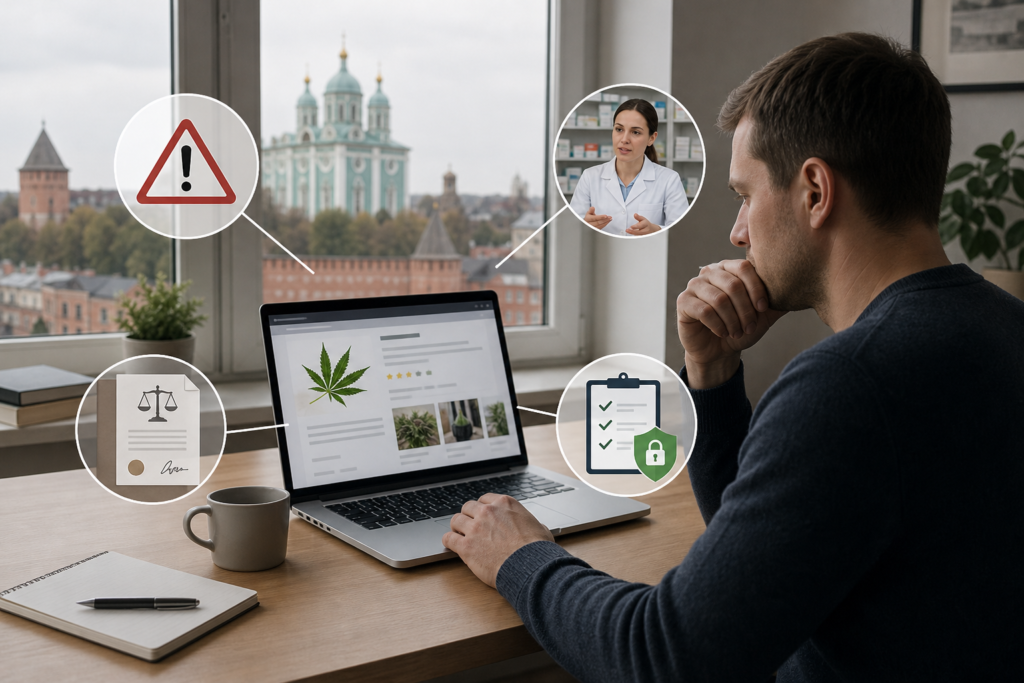
How to recognise risky sellers and common scams
Promises that sound too good to be true
Scammers commonly promise guaranteed delivery, unusually low prices, instant refunds, or products that supposedly have no legal risk. They may claim to have special access to law enforcement, customs, doctors, or laboratories. These statements are designed to create confidence without providing evidence.
Requests for irreversible payment
Requests for cryptocurrency, gift cards, unusual payment links, or transfers to unrelated personal accounts should be treated cautiously. A seller may demand a second payment for “insurance,” “customs release,” or “address verification” after receiving the first payment. This pattern is common in advance-fee fraud, and sending more money rarely solves the problem.
Fake reviews and copied documents
Look for repeated wording, identical photographs, newly created accounts, and reviews that discuss speed but never mention ingredients, testing, or lawful business details. A certificate shown as a screenshot is not meaningful unless its issuer, date, batch number, and authenticity can be independently checked.
Pressure and secrecy
Be cautious if someone insists on an immediate decision, discourages questions, asks for identity documents without a clear lawful reason, or tells you to conceal the transaction from a doctor or family member. Legitimate health services should explain privacy practices and consent rather than use fear or urgency.
Health risks associated with unverified cannabis products
Unregulated products may contain a different concentration from the label or may be contaminated with solvents, pesticides, mould, heavy metals, or other psychoactive substances. Synthetic cannabinoids and novel psychoactive compounds can be especially unpredictable. Packaging that looks professional does not establish safety.
Effects may also vary according to dose, route of administration, tolerance, age, existing conditions, and interactions with medicines or alcohol. Possible problems can include anxiety, impaired coordination, confusion, vomiting, rapid heartbeat, and worsening of some mental-health symptoms. Driving or operating machinery after using an intoxicating substance creates a serious safety risk.
For balanced public-health information about cannabis effects and risks, consult the World Health Organization’s cannabis information. Seek urgent medical help if someone has severe confusion, chest pain, difficulty breathing, a seizure, loss of consciousness, or behaviour that creates an immediate danger.
Safer legal alternatives in Smolensk
If your interest in cannabis in Smolensk is connected to pain, sleep, anxiety, appetite, or another health concern, begin with a licensed healthcare professional. Explain your symptoms, current medicines, previous treatments, and any substance use honestly. A clinician can help assess possible causes and discuss treatments that are lawful and appropriate for your circumstances.
For non-medical reasons, consider options that do not expose you to an unknown product or criminal liability. Depending on your goal, this might include exercise, sleep support, psychological counselling, physiotherapy, relaxation techniques, or an approved over-the-counter product used according to its label. A pharmacist can help identify interactions and contraindications, while a doctor can refer you to an appropriate service.
Be careful with products marketed as CBD, hemp, incense, or “legal highs.” Names used in advertising do not automatically determine legal status or safety. Check the current ingredient rules and labelling requirements before purchasing any product, and avoid items with no full ingredient list, no manufacturer information, or no credible testing.
What to do if you have already contacted a seller
- Stop sending money or personal information until the seller and product can be independently verified.
- Save messages, payment records, usernames, URLs, delivery promises, and product photographs.
- Do not collect an unknown package on behalf of another person or agree to reship anything.
- If you suspect fraud, contact your bank or payment provider promptly and ask what protective steps are available.
- If you received a product and feel unwell, seek medical advice and provide the packaging or ingredient information if available.
- For legal questions, consult a qualified lawyer rather than asking the seller whether the transaction is safe.
Do not attempt to test an unknown substance by taking a larger amount, combining it with alcohol or medicines, or giving it to another person. Avoid posting identifying information publicly while seeking help, since scammers may use personal details to demand more money.
A practical checklist before trusting any online claim
- Can the organisation be identified independently outside its own social-media channel?
- Is the product legal for sale and possession in the relevant jurisdiction?
- Are ingredients, warnings, concentration, and batch details clearly documented?
- Can laboratory information be verified with the laboratory itself?
- Does the seller allow reasonable questions without pressure?
- Are payment, refund, privacy, and complaint procedures clear?
- Would you be comfortable discussing the product with a doctor or lawyer?
If several answers are no, walking away is the safer decision. The absence of reliable information is itself important information.
Conclusion
There is no reliable shortcut to finding trusted weed sellers in Smolensk when the market is unregulated or illegal. Professional-looking pages, reviews, and delivery promises cannot replace lawful licensing, transparent testing, and independent verification. Focus on the current legal position, protect your money and personal data, and avoid products with unknown contents.
If the underlying reason is medical, speak with a licensed healthcare professional. If you suspect fraud or face legal exposure, preserve evidence and obtain advice from the appropriate official or professional service. A cautious decision may be less convenient than an anonymous purchase, but it is far more likely to protect your health, finances, and future.

The Ziklane Editorial Team is dedicated to providing accurate, well-researched, and up-to-date information on cannabis laws and regulations around the world. Our content is created through careful research of publicly available legal sources, government publications, and reputable references to help readers better understand local cannabis legislation. We are committed to delivering educational, factual, and regularly updated content while encouraging readers to comply with the laws of their respective countries and regions.