
People searching for Online retailers selling weed in Kiryat Malakhi may find websites offering cannabis products, delivery, or assistance with medical access. However, a polished website does not prove that a seller is licensed, that its products are legal, or that a delivery service operates lawfully. In Israel, cannabis access depends on the product, the seller, the buyer’s authorization, and the rules in force at the time of purchase.
This guide explains how residents can assess online cannabis claims without relying on anonymous advertisements. It focuses on lawful medical access, consumer safety, privacy, and scam prevention rather than directing readers to unverified sellers. Rules and enforcement can change, so anyone considering cannabis should confirm current requirements through official Israeli sources and speak with an appropriately qualified healthcare professional.
What online cannabis retail means in Kiryat Malakhi
Online cannabis retail can describe several different services. A website might belong to a licensed medical cannabis business, a pharmacy or delivery provider, a company selling permitted accessories, or an unlicensed seller marketing products outside the regulated system. These categories are not interchangeable.
Some websites use terms such as “premium,” “same-day,” or “discreet delivery” to create an impression of legitimacy. Marketing language is not a substitute for a verifiable license, a lawful prescription or authorization process, clear product information, and a traceable business identity. A seller that refuses to identify its legal entity or explains that no documentation is required deserves particular caution.
Why location still matters
Kiryat Malakhi is a specific delivery location, but the relevant legal framework is national rather than based only on the city. A retailer may advertise delivery to Kiryat Malakhi while operating from another area, and delivery claims do not establish that the transaction is permitted. Buyers should distinguish between local availability and lawful availability.
Searching for weed in Kiryat Malakhi can also produce listings for products that are not medical cannabis, are inaccurately labeled, or are not intended for lawful retail. Treat location-based search results as leads for verification, not as endorsements.
Online retailers selling weed in Kiryat Malakhi: how to assess legality
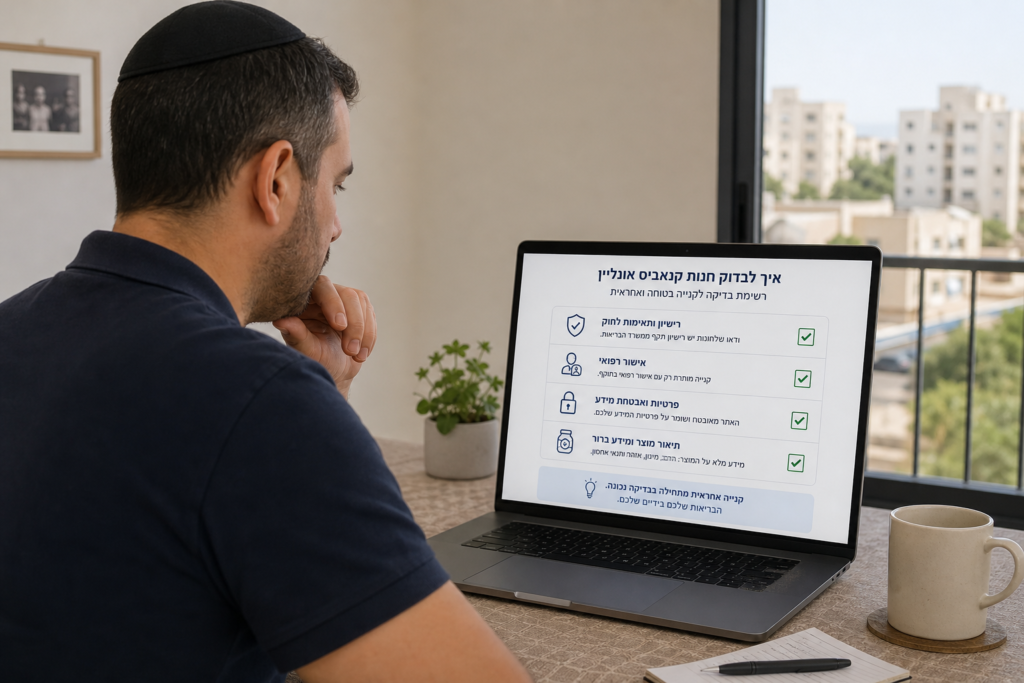
The most important question is not whether a site accepts online orders. It is whether the full transaction complies with Israeli law. A legitimate medical cannabis process should involve appropriate authorization, an identifiable regulated supply chain, and procedures for confirming the customer’s eligibility and identity.
Readers can consult the Israeli government’s official cannabis information portal for current guidance. If a seller’s process conflicts with official requirements, promises access without medical authorization, or encourages customers to conceal the transaction, avoid it.
Information a credible provider should make clear
- The registered business name and a reliable way to contact it.
- Whether it is selling medical cannabis, permitted non-cannabis products, or another category.
- What authorization, prescription, or identification is required.
- How products are sourced, packaged, stored, and delivered.
- How customers can report a problem, request a refund, or raise a product-safety concern.
- Which privacy and payment practices apply to customer information.
No single item proves that a business is authorized, but missing information is a warning sign. A retailer that provides only a messaging-app number, uses several unexplained brand names, or avoids questions about licensing should not be treated as a dependable provider.
Medical cannabis in Kiryat Malakhi: the safer legal route
For patients, the appropriate starting point is healthcare guidance rather than a search engine. A doctor or authorized clinic can explain whether medical cannabis may be suitable, what alternatives exist, and what documentation is needed. Treatment decisions should take account of existing conditions, medicines, age, pregnancy status, mental-health history, and potential impairment.
After authorization, patients should use the regulated channel described by official authorities. A medical cannabis product should have clear labeling and instructions. Patients should be able to identify the product, understand its cannabinoid content as provided by the supplier, and receive information about storage and use. If a website offers a product without these basics, it may not be part of a reliable medical supply chain.
The World Health Organization’s cannabis information explains that cannabis can affect attention, memory, coordination, and judgment, and that health risks vary by person and pattern of use. This is one reason online purchasing should not replace professional advice or product controls.
Questions to ask a healthcare professional
- What is the intended medical goal and how will progress be evaluated?
- Could cannabis interact with current medicines or worsen an existing condition?
- What dose, form, and schedule are appropriate?
- What symptoms should prompt stopping use or seeking urgent help?
- Is driving, operating machinery, or working in a safety-sensitive role affected?
These questions are more useful than relying on testimonials or product descriptions. Individual experiences online cannot establish that a product is safe or suitable for another person.
Red flags when comparing cannabis websites
Consumers searching for cannabis in Kiryat Malakhi may encounter websites that appear professional but have limited accountability. The following signs should encourage caution:
- No authorization required: A seller promises delivery to anyone without checking eligibility where authorization is required.
- Unusually broad product claims: A listing promises to treat many unrelated diseases or guarantees a specific medical result.
- No product traceability: There is no batch information, labeling, responsible supplier, or way to verify what is being sold.
- Pressure to pay quickly: The seller demands cryptocurrency, gift cards, or an irreversible transfer before answering basic questions.
- Identity collection without explanation: The site requests identity documents or sensitive medical information without a clear privacy policy.
- Inconsistent business details: The website, payment recipient, invoices, and customer-service names do not match.
- Suspicious urgency: Countdown timers, limited-stock messages, or threats of account closure are used to rush a purchase.
Any one of these issues may have an innocent explanation, but several together indicate a high risk of fraud, privacy loss, unsafe products, or legal trouble. Do not send identity documents or health records to an unknown seller simply because it claims to offer discreet service.
Delivery, privacy, and personal safety
A delivery promise is not proof that a transaction is legal. Before sharing an address, customers should understand what information is collected, why it is needed, how long it is retained, and whether it is shared with delivery contractors or other companies. A secure connection is useful, but it does not prove that the business itself is legitimate.
Use caution with links sent through unsolicited messages. Check the spelling of the domain, review the company’s contact details, and avoid reusing passwords. Keep copies of receipts and correspondence if a transaction has already taken place. If payment details or identity documents may have been exposed, contact the relevant bank or payment provider promptly and change affected passwords.
Consumers should also consider practical safety. Do not meet an unknown seller alone, invite an unidentified courier into a private residence, or accept a package whose contents and sender cannot be established. If a product arrives with damaged packaging, unclear labeling, an unusual smell, or no reliable instructions, do not use it.
Understanding cannabis laws in Kiryat Malakhi
Searches for cannabis laws in Kiryat Malakhi can be misleading because online summaries often combine old rules, personal opinions, and information from other countries. The legal treatment of possession, supply, cultivation, medical use, advertising, and driving is not necessarily the same. A rule that applies to one category of product may not apply to another.
Do not assume that decriminalization, administrative enforcement, or medical access means that every purchase is legal. Likewise, a seller’s claim that a product is “natural,” “CBD,” or “for research” does not automatically remove legal or health requirements. Check the current position with official authorities before ordering, particularly if the product contains THC or is marketed for therapeutic use.
Drivers should take extra care. Cannabis may impair reaction time and judgment, and legal questions around driving can be separate from questions about possession or purchase. Anyone who uses cannabis should obtain professional guidance about impairment and avoid driving or performing hazardous work when affected.
What to do if an online transaction goes wrong
If a seller takes payment and does not deliver, sends an unexpected product, threatens a customer, or misuses personal data, preserve evidence. Save the website address, order confirmation, payment record, messages, delivery details, and photographs of packaging. Do not send additional money to “unlock” a refund or resolve a customs problem without independently verifying the claim.
- Contact the payment provider through its official website or telephone number.
- Change passwords if an account may have been compromised.
- Monitor bank and payment statements for unfamiliar activity.
- Report suspected fraud or threats to the appropriate Israeli authorities.
- Seek medical help promptly if anyone experiences a concerning reaction to an unknown product.
Do not publicly post another person’s private information in an attempt to recover money. A factual record shared with the relevant authority is safer and more useful than online confrontation.
A practical checklist before considering any retailer
Use this checklist to organize a decision without treating it as a guarantee of legality:
- Can the business identity and legal status be independently verified?
- Does the service explain the authorization or prescription process?
- Are product labels, storage information, and supplier details clear?
- Are prices, delivery charges, refunds, and payment methods transparent?
- Does the privacy policy explain the handling of medical and identity data?
- Does the business avoid exaggerated medical claims and pressure tactics?
- Would a qualified healthcare professional consider the product and process appropriate?
If the answer to several questions is no, the safest choice is not to proceed. A retailer’s convenience cannot compensate for unknown product contents, unverified legality, or exposure to fraud.
Conclusion
Finding online retailers selling weed in Kiryat Malakhi requires more than comparing delivery times or product menus. The key issues are lawful authorization, medical suitability, product traceability, privacy, and protection from scams. Residents should verify current Israeli requirements through official sources, consult a qualified healthcare professional when seeking medical cannabis, and avoid sellers that promise effortless access without documentation.
Whether a search uses “weed,” “cannabis,” or “medical cannabis,” the same principle applies: treat online claims cautiously, verify before sharing personal information, and choose regulated channels whenever the law permits access.

The Ziklane Editorial Team is dedicated to providing accurate, well-researched, and up-to-date information on cannabis laws and regulations around the world. Our content is created through careful research of publicly available legal sources, government publications, and reputable references to help readers better understand local cannabis legislation. We are committed to delivering educational, factual, and regularly updated content while encouraging readers to comply with the laws of their respective countries and regions.