
People searching for online retailers selling weed in Nizhnevartovsk may find websites, social-media accounts, and messaging-channel advertisements that appear to offer delivery. The important distinction is that an online listing does not make a product legal. In Russia, cannabis and cannabis-containing substances are subject to strict controls, and ordinary online retail is not a lawful way for consumers to purchase them.
This guide explains what residents of Nizhnevartovsk should know before responding to such advertisements. It focuses on legal awareness, fraud prevention, personal safety, and legitimate ways to obtain health information. It does not provide seller names, contact details, prices, delivery instructions, or methods for evading law enforcement.
Are there legal online weed retailers in Nizhnevartovsk?
There is no ordinary legal consumer market for recreational cannabis in Nizhnevartovsk. A website or private account claiming to sell cannabis does not have the status of a licensed pharmacy or an authorized medical provider. Products promoted as marijuana, hashish, cannabis, THC, or similar substances can create serious criminal and health risks, even when an advertisement uses terms such as “organic,” “private,” “discreet,” or “for research.”
The legal position depends on the substance, its concentration, its form, and the activity involved. Possession, purchase, transfer, production, and distribution can raise different legal issues. The fact that a seller operates through an encrypted messenger, accepts cryptocurrency, or promises delivery to Nizhnevartovsk does not change those issues.
For current statutory information, readers should consult the official Russian legal information portal and check the current wording of applicable laws and regulations. Rules can change, and a qualified Russian lawyer is the appropriate source for advice about a particular situation.
What searches for weed in Nizhnevartovsk usually reveal
Search results for weed in Nizhnevartovsk can mix illegal offers with unrelated products, news reports, general drug-information pages, and advertisements for substances that may be mislabeled. A polished site, customer-review section, or delivery map is not proof that a seller is genuine or authorized.
Common warning signs
- Requests for prepayment through cryptocurrency, anonymous transfers, or gift cards.
- Promises of guaranteed delivery, complete anonymity, or protection from legal consequences.
- Pressure to move immediately from a public website to a private chat.
- Claims that a product is legal solely because it is described as “technical,” “light,” or “CBD.”
- Unclear ingredients, missing laboratory information, or photographs that do not identify the actual product.
- Requests for passport details, selfies, banking credentials, or access to a personal account.
- Offers to reship an order after an extra payment for “customs,” “insurance,” or “clearance.”
These signs do not prove that every advertisement is a scam, but they indicate that a user should stop communicating and avoid sending money or personal information. An illegal seller cannot provide the normal consumer protections associated with a regulated retailer.
Cannabis in Nizhnevartovsk: legal and health risks
Searching for cannabis in Nizhnevartovsk can expose a person to two separate categories of risk. The first is legal exposure. A buyer may not know the true contents of a package, the quantity involved, or whether the seller has added another substance. Digital messages, payment records, delivery arrangements, and possession may all become relevant in an investigation.
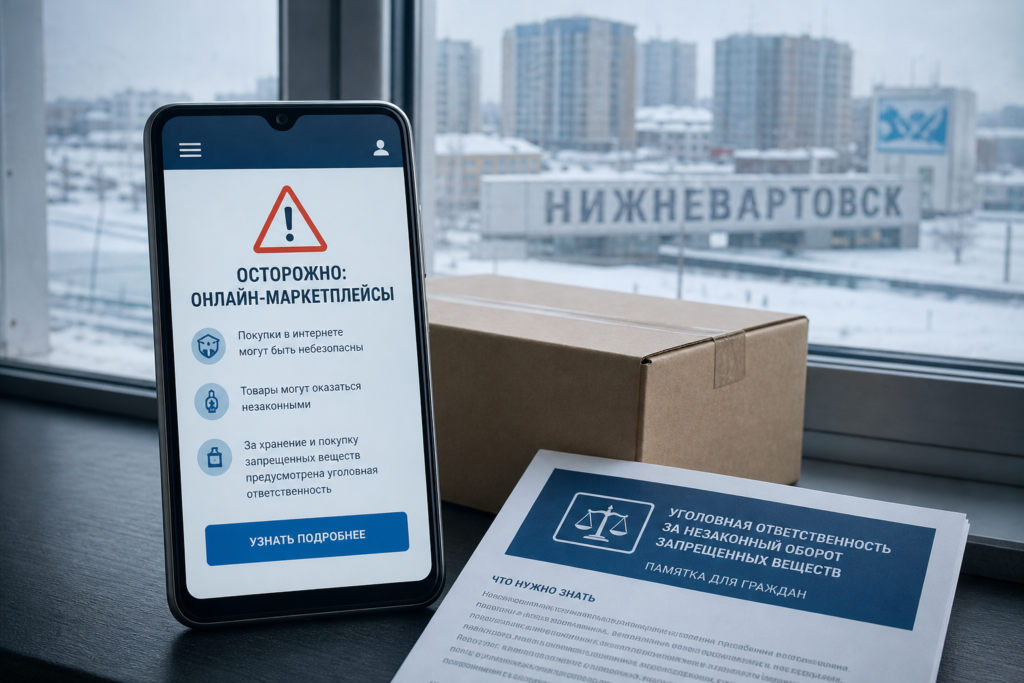
The second is health uncertainty. Unregulated products may have unknown potency, contaminants, synthetic cannabinoids, or a different substance from the one advertised. Packaging and a seller’s informal claims are not a substitute for independent quality control. Combining an unknown product with alcohol, prescription medicine, or other drugs can increase the chance of an adverse reaction.
Anyone who believes they have taken an unknown substance and is experiencing severe anxiety, confusion, loss of consciousness, chest pain, breathing difficulty, seizures, or persistent vomiting should seek emergency medical help immediately. Do not drive, and tell medical professionals what was taken if that information is available.
Why “legal alternatives” can still be misleading
Some online advertisements use hemp, CBD, or low-THC language to suggest that any cannabis-related product is safe and lawful. That conclusion cannot be drawn from a product name alone. The applicable rules may depend on the product’s composition, documentation, intended use, and method of sale. A seller’s statement that an item is “legal in Russia” is not an official determination.
Consumers should be particularly cautious with oils, edibles, vapes, powders, and herbal mixtures sold without clear labeling. Even when a product is marketed as a supplement or aromatherapy item, it may not have been manufactured or tested to a standard that protects the buyer.
Understanding cannabis laws in Nizhnevartovsk
Cannabis laws in Nizhnevartovsk are primarily shaped by federal Russian law rather than by a separate city-level recreational cannabis system. Local authorities, police, courts, and healthcare institutions operate within that national framework. Residents should therefore avoid relying on foreign websites, overseas legalization maps, or advice written for another country.
Legal questions can involve several different facts: the substance involved, the amount, the person’s age, the location, the purpose of possession, and whether another person was supplied. A person who is concerned about a past purchase or an encounter with a seller should preserve relevant messages without forwarding illegal material, avoid further contact, and obtain confidential legal advice.
The official website of the Russian Ministry of Internal Affairs provides public information about law enforcement and safety matters. It should not be treated as a substitute for individualized legal advice, but it is a more reliable starting point than anonymous posts or seller-generated explanations.
How to avoid online cannabis scams
When a site or account offers cannabis delivery to Nizhnevartovsk, the safest response is not to place an order. Do not send an advance payment to “unlock” a catalog, verify an address, release a parcel, or recover a failed transaction. Scam operators often use a sequence of small extra charges after the first payment, while the promised product is never delivered.
- Stop the conversation if the seller asks for unusual personal information or immediate payment.
- Do not download unknown applications, open suspicious attachments, or share one-time banking codes.
- Save the page address, usernames, payment details, and messages if you may need to report fraud.
- Contact your bank promptly if money or account information has been sent.
- Report suspected online fraud through appropriate official channels and seek legal advice when necessary.
Do not attempt to test an unknown product personally or pass it to someone else. If a package has arrived and its contents are uncertain, avoid opening or handling it unnecessarily and ask a lawyer or the relevant authorities how to proceed.
Safer legal options for health concerns
Some people search for online weed retailers because they are trying to manage pain, insomnia, anxiety, appetite changes, or another health problem. An anonymous seller is not a reliable substitute for diagnosis or treatment. A licensed doctor can assess symptoms, review existing medicines, and discuss treatments that are lawful and appropriate in Russia.
Prepare a short record of symptoms, their duration, current medicines, allergies, and any relevant medical history before an appointment. Be honest with a healthcare professional about substances already used; accurate information helps clinicians assess risk and provide safer care.
Questions to ask a healthcare provider
- What could be causing the symptoms?
- Which approved treatments or non-drug options are available?
- Could current medicines interact with alcohol, supplements, or other substances?
- Which warning signs require urgent medical attention?
- What follow-up plan should be used if symptoms continue?
For general health information, use recognized medical institutions and public-health sources rather than commercial cannabis advertisements. Online information can support a conversation with a clinician, but it should not replace an examination or a prescription where one is needed.
What a trustworthy online health service should look like
A legitimate healthcare website should clearly identify the provider, explain its services, show contact details, protect personal information, and avoid promises of guaranteed cures. If medication is involved, the provider should direct patients through a lawful medical process rather than offer anonymous delivery of an unverified substance.
Be wary of testimonials that cannot be verified, countdown timers, “limited stock” pressure, and claims that doctors or regulators are hiding a miracle treatment. These techniques are common in health scams and can distract from the basic questions of legality, evidence, quality, and clinical supervision.
Conclusion
People looking for online retailers selling weed in Nizhnevartovsk should understand that online availability is not evidence of legality, safety, or product quality. Ordinary recreational cannabis delivery is not a lawful retail option, and anonymous sellers may expose buyers to legal proceedings, fraud, privacy loss, and unknown health hazards.
The safer approach is to avoid purchasing or sharing unregulated substances, verify legal information through official sources, report suspected fraud, and speak with a qualified healthcare professional about medical concerns. Treat claims about weed delivery, cannabis products, and “legal” alternatives with caution—especially when the seller demands secrecy, immediate payment, or personal data.

The Ziklane Editorial Team is dedicated to providing accurate, well-researched, and up-to-date information on cannabis laws and regulations around the world. Our content is created through careful research of publicly available legal sources, government publications, and reputable references to help readers better understand local cannabis legislation. We are committed to delivering educational, factual, and regularly updated content while encouraging readers to comply with the laws of their respective countries and regions.