
Anyone researching purchasing weed in Monsefú, Peru should begin with the legal and health context rather than with informal seller recommendations. Cannabis rules can distinguish between medical use, possession, cultivation, transport, and sale, and those distinctions matter. Local availability, social media claims, and word-of-mouth offers are not proof that a product or transaction is lawful.
This guide is designed to help residents and visitors make safer, more informed decisions. It does not identify sellers, arrange purchases, or encourage transactions outside Peru’s regulated framework. Instead, it explains how to check official information, recognize warning signs, protect personal information, and seek professional help when cannabis is being considered for medical reasons.
Start by checking cannabis laws in Monsefú
Monsefú is in the Lambayeque region, but national Peruvian law is the main starting point for understanding cannabis. Municipal custom or an informal local practice does not override national regulations. Before possessing, transporting, growing, or purchasing cannabis, check current guidance from Peruvian authorities and confirm whether it applies to your specific situation.
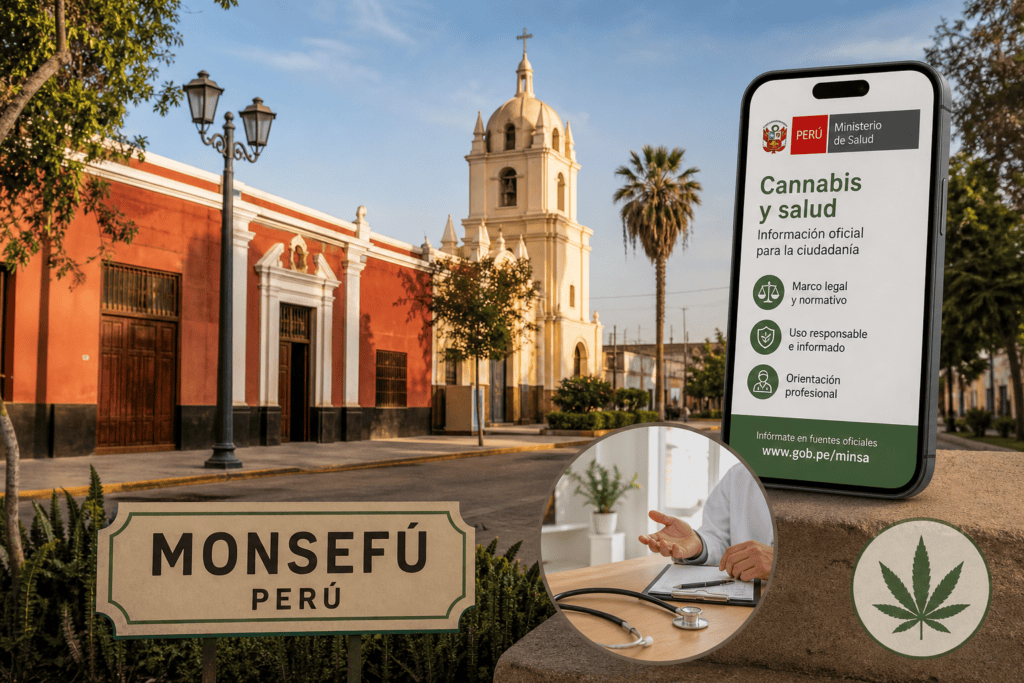
The Peruvian Ministry of Health is an appropriate official source for health-related information and regulatory updates. Because rules and administrative requirements can change, avoid relying solely on old blog posts, screenshots, messaging-group claims, or advice from an unlicensed seller.
It is also important to separate medical cannabis from recreational use. A product marketed as “medicinal” is not automatically approved, tested, or suitable for a particular condition. Ask whether the product comes through a legally recognized channel, whether its labeling can be verified, and whether a qualified health professional has recommended it.
Questions to resolve before taking any action
- Is the intended use medical, personal, or recreational?
- Does the relevant Peruvian framework permit the specific product and transaction?
- Would possession or transport create a problem at a checkpoint, border, airport, hotel, or workplace?
- Are there prescription, registration, age, packaging, or documentation requirements?
- Can a licensed health professional explain potential risks and alternatives?
What to know about weed in Monsefú before considering a product
Searching for weed in Monsefú may produce informal advertisements, social media accounts, delivery offers, or private invitations. None of these channels independently confirms legality, product quality, or the identity of the person offering cannabis. Anonymous listings can also expose people to fraud, extortion, theft, contaminated products, or legal trouble.
There may be no simple, publicly verifiable retail directory for lawful cannabis sales in a particular district. Treat claims such as “guaranteed legal,” “government approved,” or “safe for everyone” as unverified until supported by official documentation and professional advice. Do not interpret a polished logo, a menu, or customer reviews as evidence of licensing.
For broader context, the World Health Organization’s cannabis information describes health considerations that are relevant regardless of where a product is offered. Cannabis can affect attention, coordination, memory, and judgment, and risks may vary according to the person, product, dose, frequency of use, and other substances.
Safer ways to evaluate a possible legal option
If a person is considering a lawful medical route, the safest first step is a consultation with a qualified doctor or other authorized health professional. Be open about current medicines, mental-health history, pregnancy or breastfeeding, heart conditions, and previous reactions to cannabis. A clinician can discuss whether cannabis is appropriate and whether better-studied treatments exist.
Look for verifiable information
- Use official government or health-institution information to check the current legal framework.
- Ask for the legal name and authorization details of any regulated provider, where applicable.
- Confirm that packaging identifies the product, responsible entity, ingredients, and relevant warnings.
- Prefer products with reliable laboratory information rather than unverified potency claims.
- Keep receipts, prescriptions, and other lawful documentation when applicable.
Do not attempt to bypass requirements by using someone else’s prescription, changing labels, concealing cannabis during travel, or presenting a product as something else. Such actions can create additional legal and safety risks.
Protect your privacy and finances
Informal sellers may ask for identity documents, home addresses, live location, intimate photographs, or advance payment. These requests are serious warning signs. Do not send unnecessary personal information, transfer money to an unknown account, or meet a stranger alone. Be especially cautious of offers that demand urgency, secrecy, cryptocurrency, gift cards, or a deposit before showing any verifiable details.
If you receive threats, blackmail, or suspected fraud, preserve messages and payment records, stop communicating when safe to do so, and contact appropriate local authorities or a trusted legal adviser. Do not retaliate or attempt to recover money through confrontation.
Health and safety considerations for cannabis in Monsefú
People looking for cannabis in Monsefú should consider more than the source. Cannabis products can differ substantially in strength and composition. Edibles and concentrated products may have delayed or unpredictable effects, while products from an uncontrolled source may contain unknown ingredients or contaminants.
- Do not drive, ride a motorcycle, operate machinery, or work at heights after using cannabis.
- Do not combine cannabis with alcohol, sedatives, or other intoxicating substances.
- Keep cannabis away from children, pets, and anyone who could mistake it for food or medicine.
- Do not share prescribed or medically supplied products with another person.
- People who are pregnant, breastfeeding, underage, or managing a serious medical or mental-health condition should seek professional advice before use.
- Stop and seek medical attention if severe confusion, chest pain, difficulty breathing, fainting, seizure, or extreme agitation occurs.
Delayed effects are particularly important with edible products. Taking more because the first amount seems inactive can increase the chance of an unpleasant or dangerous reaction. A calm, supervised environment and access to help are safer than using an unfamiliar product in public or while traveling.
How to recognize misleading recommendations
Search results and online discussions about medical cannabis in Monsefú can mix legitimate health information with advertising. Evaluate the source carefully. A responsible article or provider should explain limitations, identify the relevant authority, avoid guaranteed cures, and encourage professional consultation.
Be skeptical of claims that cannabis treats every disease, has no side effects, or is “100% safe.” Be equally skeptical of testimonials that cannot be independently verified. A seller who refuses to discuss ingredients, legal status, packaging, or health warnings is not providing enough information for a responsible decision.
Other warning signs include unusually low prices, pressure to meet immediately, requests to move every conversation to an encrypted account, inconsistent product names, unexplained changes in potency, and offers to deliver across borders or through concealed packaging. These situations are not merely quality concerns; they may involve fraud or unlawful distribution.
Travel, transport, and public settings
Do not assume that a product acquired in one Peruvian location can be carried freely to another. Transport rules may apply even when possession is treated differently in another context. Airports, hotels, schools, workplaces, public events, and border crossings may have additional restrictions or enforcement risks.
Visitors should avoid carrying cannabis for another person, accepting packages from strangers, or placing an unidentified product in luggage. Residents should also avoid storing cannabis where children, visitors, or household workers can access it. When in doubt, obtain direct legal advice rather than relying on a social-media comment.
For readers comparing general approaches in other Peruvian locations, related safety-focused guides include the weed buying guide for Chancay and recommendations for purchasing weed in Tambo Grande. These articles should be treated as general educational material, not as confirmation that a product or seller is legal in Monsefú.
A practical checklist before making a decision
- Define the reason for considering cannabis and discuss it with a qualified health professional if it relates to a medical condition.
- Check current information from Peruvian authorities instead of relying on informal local claims.
- Confirm whether the product, provider, and intended transaction fit the applicable legal framework.
- Reject offers involving secrecy, threats, advance payment, unverifiable credentials, or unknown packaging.
- Plan for safety: no driving, no mixing with alcohol or sedatives, and secure storage away from children and pets.
- Keep relevant lawful documentation and avoid transporting cannabis where rules are unclear.
- Seek urgent medical help for severe or unexpected symptoms.
Conclusion
Responsible purchasing weed in Monsefú, Peru begins with verification, not with finding the fastest informal contact. Cannabis laws, product standards, and medical requirements should be checked through reliable authorities, while health decisions should involve a qualified professional. Avoid anonymous sellers, unsupported medical promises, unsafe payment requests, and any attempt to conceal or transport cannabis unlawfully.
If no clearly lawful and verifiable option is available, the safest decision is not to proceed. Careful research, privacy protection, professional advice, and respect for local regulations are more valuable than a convenient but uncertain purchase.

The Ziklane Editorial Team is dedicated to providing accurate, well-researched, and up-to-date information on cannabis laws and regulations around the world. Our content is created through careful research of publicly available legal sources, government publications, and reputable references to help readers better understand local cannabis legislation. We are committed to delivering educational, factual, and regularly updated content while encouraging readers to comply with the laws of their respective countries and regions.