
People searching for online retailers selling weed in Nyagan may encounter websites, social-media accounts, private messages, or classified advertisements claiming to offer cannabis delivery. A listing is not proof that a seller is legal, licensed, or trustworthy. In Nyagan, as elsewhere in Russia, cannabis-related purchases can create serious legal, financial, and personal-safety risks.
This guide explains how to assess such information without helping anyone arrange an illegal purchase. It covers the legal context, warning signs of fraud, privacy concerns, and safer ways to seek medical or wellbeing support. Laws and enforcement practices can change, so residents should verify important questions with a qualified Russian lawyer or an official authority.
What online retailers selling weed in Nyagan usually means
The phrase can refer to several different types of online activity. Some pages are ordinary-looking storefronts, while others operate through messaging apps, anonymous marketplaces, or temporary websites. Some may advertise cannabis flower, concentrates, edibles, seeds, or products described as CBD. These categories are not automatically treated alike under local law, and a product label does not determine its legal status.
A website may also be a simple scam. Criminals often copy the language and design of legitimate e-commerce businesses, request advance payment, and then disappear. Other schemes collect identity documents, bank details, phone numbers, or cryptocurrency payments. Even clicking through to an anonymous marketplace can expose a visitor to malware, extortion, or attempts to recruit them into illegal activity.
Why a local delivery claim does not make a sale lawful
A seller may claim to deliver within Nyagan, Khanty-Mansi Autonomous Okrug, or another Russian region. That claim does not establish authorization. A local address, Russian-language customer support, customer reviews, or a promise of discreet packaging is not the same as a government license or a lawful supply chain.
Consumers should also be cautious with statements such as “legal,” “doctor approved,” “laboratory tested,” or “for personal use.” These are marketing claims unless supported by verifiable documentation from a competent authority. Do not assume that an online checkout process, an age gate, or a product certificate makes a transaction lawful.
Cannabis laws in Nyagan and the wider Russian legal context
Nyagan is in Russia, so the relevant legal framework is primarily federal rather than a special municipal cannabis regime. Cannabis, cannabis resin, and related controlled substances are subject to strict controls. Possession, acquisition, production, transportation, and sale may lead to administrative or criminal consequences depending on the substance, quantity, circumstances, and conduct involved.
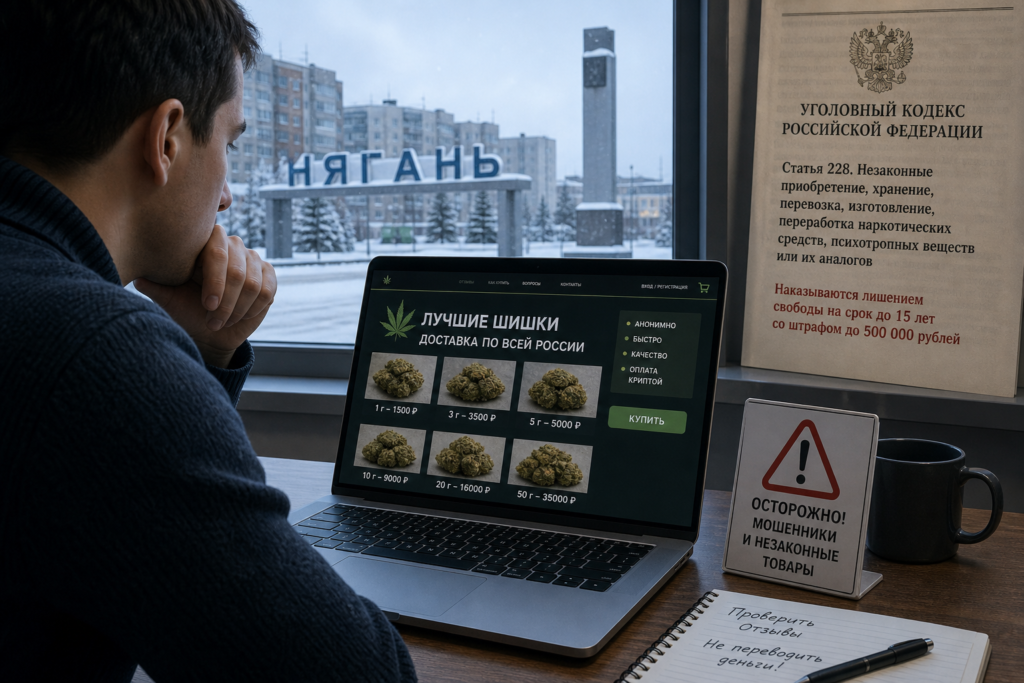
That distinction matters. A person may face risk not only when selling a product but also when ordering, receiving, storing, transporting, or sharing it. The fact that a purchase is made online, paid for remotely, or described as “for personal use” does not remove those risks. A parcel or meeting arranged through an online listing can create evidence and safety concerns for the buyer as well as the seller.
For general legal information, consult the official Russian legal information portal and seek advice from a licensed lawyer for a specific situation. Do not rely on a seller’s interpretation of Russian law, anonymous forum posts, or outdated articles.
What about medical cannabis in Nyagan?
Searching for medical cannabis in Nyagan can reflect a genuine need for pain relief, sleep support, nausea management, or help with another health condition. However, a medical need does not automatically create permission to purchase controlled cannabis products online. Patients should not assume that a foreign prescription, an imported product, or a product advertised as therapeutic will be recognized in Russia.
A safer starting point is a consultation with a licensed doctor in Russia. Explain the symptoms, current medicines, previous treatments, and any side effects. A physician can assess the condition, identify contraindications, and discuss lawful treatment options. People with urgent symptoms, severe medication reactions, or a risk of self-harm should contact emergency medical services rather than an online seller.
For broader evidence-based information about cannabis, its effects, and health risks, review the World Health Organization’s cannabis information. International health information does not override Russian law, but it can help readers distinguish medical evidence from promotional claims.
How to recognize a risky or fraudulent cannabis listing
There is no reliable way for an ordinary buyer to make an illegal online cannabis purchase safe. Nevertheless, recognizing warning signs can help people avoid scams, data theft, and accidental involvement in criminal activity.
- Advance payment pressure: The seller demands cryptocurrency, gift cards, transfers to a personal account, or an unusual payment method and refuses an ordinary invoice or verifiable business details.
- Guaranteed anonymity: The listing promises that law enforcement cannot trace the order or that a delivery method eliminates legal risk. Such claims are misleading and may signal criminal intent.
- Unverifiable testing: A certificate contains no recognized laboratory, date, batch number, or contact information, or the same image appears across unrelated products.
- Urgency and scarcity: The seller uses countdowns, limited-time discounts, or threats that an offer will disappear unless payment is made immediately.
- Requests for sensitive data: A seller asks for passport scans, banking credentials, access codes, or unnecessary photographs.
- Suspicious downloads: The website requires an app, browser extension, document, or file before showing basic product information.
- Unrealistic health promises: Claims that cannabis cures cancer, replaces prescribed treatment, or has no side effects should be treated as major red flags.
Privacy and personal safety concerns
People researching weed in Nyagan may be tempted to contact several sellers to compare prices or delivery terms. Doing so can increase exposure to phishing, blackmail, malware, and unwanted contact. Avoid sending identity documents or intimate images, and never share banking passwords, one-time verification codes, or access to government-service accounts.
If you have already contacted a suspicious seller, stop communicating, do not send additional money, and preserve relevant messages, payment records, usernames, and website addresses. Change reused passwords, enable two-factor authentication, and contact your bank or payment provider quickly if financial information was disclosed. If there are threats, extortion attempts, or suspected fraud, report the matter to the appropriate Russian authorities and consider speaking with a lawyer.
Do not meet an unknown seller at a private residence, isolated location, or unfamiliar property. More importantly, do not attempt to test an unknown substance. Products sold online can be mislabeled, contaminated, unexpectedly potent, or entirely different from what the listing describes. Avoid mixing unknown substances with alcohol or prescription medicines.
Legal alternatives for people seeking relief
Many searches for cannabis in Nyagan are really requests for help with pain, insomnia, anxiety, appetite, or another ongoing problem. The safest response is to address the underlying need through lawful healthcare rather than an unverified online marketplace.
- Book a medical appointment: A general practitioner or relevant specialist can investigate symptoms and recommend authorized treatment.
- Prepare a medication history: List current medicines, supplements, allergies, previous diagnoses, and treatments that have not worked.
- Ask about evidence and side effects: Request clear information about expected benefits, risks, interactions, and warning signs.
- Use licensed pharmacies: Purchase medicines only through lawful channels and follow the prescription and dosage instructions.
- Seek support for substance concerns: If cannabis use has become difficult to control, a doctor or addiction specialist can discuss confidential treatment and recovery options.
People who use prescribed medicines should not stop or replace them abruptly because of an online claim. A qualified clinician can help evaluate alternatives safely, including non-drug measures such as physiotherapy, sleep treatment, psychological support, or pain-management programs when appropriate.
Questions to ask before trusting any online health product
Whether the product is described as cannabis, CBD, hemp, or a “natural remedy,” consumers should ask basic verification questions. Is the seller a registered business? Can its license and physical details be independently confirmed? Does the product have a clear ingredient list, batch identification, expiry date, and testing information from a credible laboratory? Are the health claims consistent with advice from a licensed medical professional?
If the seller avoids straightforward answers, insists on secrecy, or says that ordinary consumer protections do not apply, leave the site. Do not confuse polished branding with accountability. A genuine healthcare provider will not ask a patient to evade the law or conceal a transaction from doctors and family members.
Practical takeaway for Nyagan residents
Online listings for cannabis may appear convenient, but convenience does not equal legality, quality, or safety. In Russia, the legal consequences of controlled-substance activity can be severe, while anonymous sellers may also expose customers to fraud and dangerous products. The safest approach is not to order from unverified retailers, not to provide sensitive information, and not to rely on claims made by sellers.
If your interest is medical, speak with a licensed doctor and use authorized treatment channels. If your concern is a suspicious website or payment request, preserve evidence and contact your bank, the platform, or the relevant authorities. If you are worried about substance use, seek professional support without waiting for the situation to worsen.
Conclusion
Searching for online retailers selling weed in Nyagan can lead to illegal offers, scams, privacy breaches, and unsafe products rather than dependable healthcare. Russian federal law is the key issue, and a seller’s promise of discreet delivery or medical quality cannot replace official authorization. Treat online cannabis listings with caution, avoid transactions that may violate the law, and choose qualified medical and legal advice when you need help.

The Ziklane Editorial Team is dedicated to providing accurate, well-researched, and up-to-date information on cannabis laws and regulations around the world. Our content is created through careful research of publicly available legal sources, government publications, and reputable references to help readers better understand local cannabis legislation. We are committed to delivering educational, factual, and regularly updated content while encouraging readers to comply with the laws of their respective countries and regions.