
Searches for Online retailers selling weed in Lobnya may produce websites, social-media accounts, classified listings, or delivery offers. However, the appearance of an online shop does not mean that it is legal, licensed, safe, or genuinely able to deliver what it advertises. For people looking for weed in Lobnya, the most important questions concern Russian law, fraud, personal safety, and health rather than which seller appears first in search results.
This guide does not recommend retailers or explain how to obtain illegal drugs. It provides practical information for evaluating online claims, recognizing common scams, understanding the local legal context, and finding safer lawful sources of help.
Are online weed retailers legal in Lobnya?
In Lobnya, as in the rest of Russia, cannabis and cannabis-derived products are subject to strict narcotics controls. Selling, distributing, purchasing, possessing, and transporting prohibited substances can create serious criminal or administrative consequences. The exact legal outcome depends on the substance, quantity, circumstances, intent, and other facts, so a short online article cannot determine the penalty for an individual situation.
Russian law can also apply to conduct that begins online. A website hosted elsewhere, an anonymous messenger account, cryptocurrency payment, or delivery arranged through a so-called “hidden” address does not make a transaction lawful. Digital anonymity is not a legal exemption, and a seller’s promise of discretion should not be treated as evidence of safety.
For primary legal texts and amendments, consult the official Russian legal information portal or obtain advice from a qualified lawyer. Avoid relying on retailer blogs, anonymous channels, or copied legal summaries when the consequences may be significant.
Why a listing is not proof of legitimacy
A professional-looking store can display product photographs, laboratory-style certificates, customer reviews, and delivery guarantees without having any independent verification. In an unregulated market, buyers may have no reliable way to confirm the identity of the seller, the contents of a package, the concentration of active compounds, or the accuracy of a label.
Some listings are designed only to collect advance payments or personal information. Others may advertise a legal-sounding product while offering something different after contact. A brand name, green leaf logo, or claim that an item is “natural” does not establish that the product is lawful or harmless.
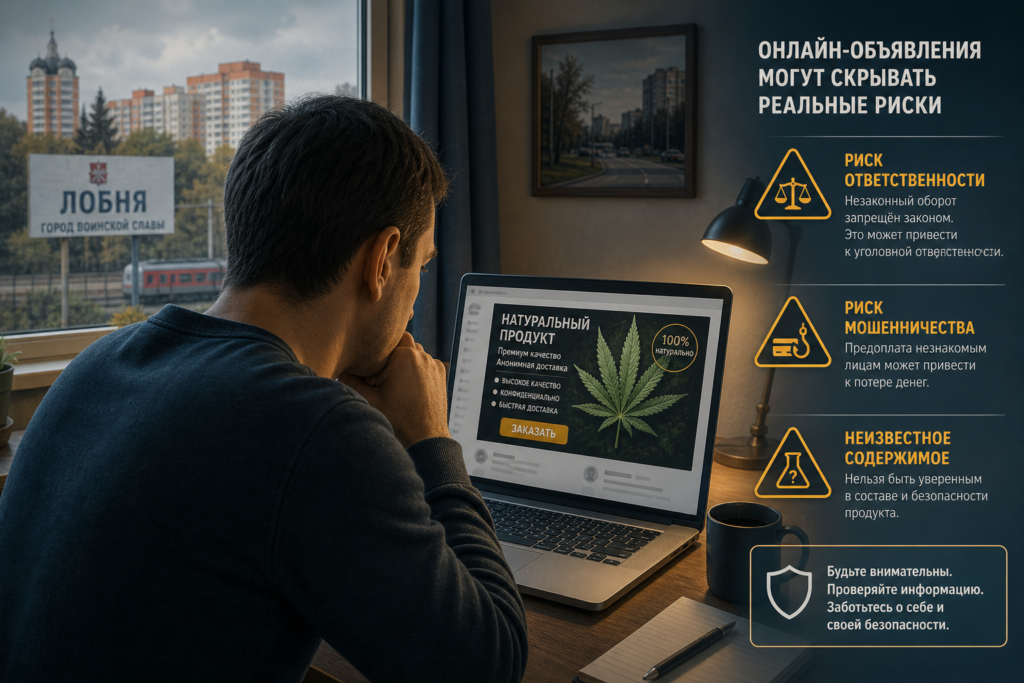
Common risks associated with cannabis in Lobnya
People searching for cannabis in Lobnya may encounter risks that are easy to overlook when communication takes place through a screen. These risks affect both the individual buyer and other people who may be exposed to the transaction.
- Legal exposure: Ordering, receiving, storing, or transferring a controlled substance may lead to investigation, detention, or prosecution.
- Financial fraud: A seller may request repeated payments for delivery, insurance, customs, verification, or a supposed refund and then disappear.
- Identity theft: Sellers may ask for passport details, photographs, bank information, home addresses, or access codes unrelated to a legitimate service.
- Unknown contents: Products sold as cannabis may contain synthetic cannabinoids, contaminants, excessive potency, or entirely different substances.
- Personal safety: Arranging a meeting with an unknown person or revealing a home address can create risks of robbery, intimidation, or harassment.
- Health effects: Cannabis can impair attention, coordination, and judgment and may worsen anxiety, paranoia, or other mental-health symptoms in some people.
The World Health Organization’s cannabis information explains that cannabis use can affect mental and physical health, with risks varying according to factors such as frequency, potency, age, and method of use. A product’s online description cannot predict how an individual will respond.
How to recognize a suspicious online seller
There is no reliable checklist that turns an illegal marketplace into a safe one. Still, certain warning signs can help people stop before sending money or personal information.
- A seller promises guaranteed delivery, complete anonymity, or immunity from law enforcement.
- The account pressures you to act immediately or claims that supplies will disappear unless payment is made at once.
- Payment is requested through unusual methods, prepaid vouchers, cryptocurrency, or transfers to unrelated individuals.
- The seller asks for additional fees after the initial payment and refuses to provide a verifiable business identity.
- Reviews appear copied, overly similar, or limited to the seller’s own channel.
- Product claims use vague terms such as “100% safe,” “legal everywhere,” or “medical grade” without independent evidence.
- The seller requests sensitive documents, one-time passwords, banking credentials, or access to a device.
- Instructions involve hidden packages, public drop points, trespassing, or meeting in isolated locations.
If several of these signs appear, stop communicating, do not send further money, and preserve relevant messages, payment records, usernames, and web addresses. Do not threaten the seller or attempt to recover money through an in-person confrontation.
Understanding cannabis laws in Lobnya
Because Lobnya is in the Moscow Region, local residents should be cautious about claims that a particular neighborhood, delivery route, or online service operates under a special local exception. Municipal location does not override national narcotics law. A product described as hemp, CBD, herbal, or imported may still be regulated depending on its composition and legal classification.
People often confuse industrial hemp, low-intoxicating products, medical research, and recreational cannabis. These are not interchangeable categories. A product’s legality may depend on its ingredients, concentration, intended use, documentation, and the rules in force at the time. Do not assume that a product sold openly in another country can be imported, possessed, or resold in Russia.
If you have already placed an order or received a message from a seller, avoid making further statements about the facts online. Keep records and seek confidential advice from a qualified lawyer who can assess your circumstances under current law.
What about medical cannabis in Lobnya?
Searching for medical cannabis in Lobnya may reflect a genuine need for relief from pain, sleep problems, nausea, anxiety, or another condition. Self-medicating with an unverified online product is risky because it can interact with prescription medicines, worsen symptoms, delay diagnosis, or expose the patient to an unknown compound.
A safer approach is to speak with a licensed doctor about the underlying condition and explain what symptoms are difficult to manage. A clinician can review current medicines, assess possible causes, and discuss treatments that are lawful and supported by appropriate evidence. If a medical appointment feels difficult, prepare a short list of symptoms, their duration, current medicines, previous treatments, allergies, and any adverse reactions.
Urgent medical help is appropriate after severe confusion, chest pain, difficulty breathing, loss of consciousness, seizures, extreme agitation, or thoughts of self-harm. If someone may have taken an unknown substance, tell emergency staff what is known and bring the packaging if it can be done safely. Do not drive the affected person yourself if their coordination or consciousness is impaired.
Safer steps for residents who encounter an online offer
- Pause before responding. Do not let urgency or attractive pricing push you into a decision.
- Do not share sensitive information. Never provide banking credentials, verification codes, passport scans, or access to personal accounts.
- Avoid sending payment. Additional transfers rarely resolve a suspicious transaction and can increase losses.
- Record the evidence. Save screenshots, payment confirmations, account names, phone numbers, and delivery instructions.
- Report the relevant fraud or threat. Contact your bank promptly about a potentially fraudulent payment and use appropriate official channels for criminal or cybercrime reports.
- Seek legal advice when necessary. A lawyer can explain your rights and obligations without relying on informal online commentary.
- Address health concerns directly. Contact a licensed healthcare professional rather than relying on an anonymous seller’s medical claims.
Legal alternatives to an online cannabis purchase
If the goal is pain relief, better sleep, reduced anxiety, or help with another health concern, the most useful next step is usually to identify the problem rather than search for a particular intoxicating product. A doctor, pharmacist, or qualified mental-health professional may be able to recommend lawful treatment, monitor side effects, and adjust care over time.
For financial or online-safety concerns, a bank’s fraud department and official reporting services are more appropriate than negotiating with a suspicious account. For substance-use concerns, confidential support from a healthcare provider can help someone reduce risk without judgment. Friends and relatives can also provide practical support, such as accompanying a person to an appointment or helping them block threatening contacts.
Conclusion
There may be many online claims about retailers selling weed in Lobnya, but visibility is not legitimacy. In Russia, cannabis-related transactions can carry serious legal consequences, while anonymous online sellers create additional risks of fraud, unsafe products, identity theft, and personal harm. Treat guarantees of secrecy, delivery, or medical benefit as warning signs rather than reassurance.
The safest course is to avoid illegal purchases, protect personal and financial information, preserve evidence of suspicious contact, and seek advice from qualified legal or healthcare professionals. If the underlying need is medical or emotional, addressing that need through lawful care is more reliable than trusting an unverified online marketplace.

The Ziklane Editorial Team is dedicated to providing accurate, well-researched, and up-to-date information on cannabis laws and regulations around the world. Our content is created through careful research of publicly available legal sources, government publications, and reputable references to help readers better understand local cannabis legislation. We are committed to delivering educational, factual, and regularly updated content while encouraging readers to comply with the laws of their respective countries and regions.