
People searching for trustworthy weed retailers in Tomsk may expect to find a licensed dispensary, a regulated delivery service, or a verified local shop. At present, that expectation does not match the legal environment in Russia. There is no ordinary legal retail market for recreational cannabis in Tomsk, and advertisements promising discreet delivery or guaranteed-quality marijuana should be treated with caution.
This guide explains how to assess such claims without directing readers to illegal sellers. It covers the main legal and safety issues, common warning signs of scams, what to do if cannabis has been offered to you, and safer ways to seek medical or wellbeing support.
Are there legal weed retailers in Tomsk?
For ordinary consumers, there is no licensed retail system in Tomsk comparable to regulated cannabis markets in some other countries. A website, social-media account, messenger channel, or shop claiming to sell recreational cannabis legally is not evidence that the business has lawful authorization. A professional logo, customer reviews, branded packaging, or a promise of laboratory testing does not change that position.
Russian rules concerning controlled substances can apply to possession, purchase, sale, transfer, cultivation, and transportation. The consequences depend on the facts of a case, including the substance, quantity, conduct, and evidence involved. Because legal classifications and enforcement can change, anyone facing a real legal situation should consult a qualified lawyer in Russia rather than rely on an online post.
The official Russian Legal Information Portal is a useful starting point for checking published legislation and government legal materials. It is more reliable than a seller’s interpretation of the law or an anonymous message-board comment.
Understanding cannabis laws in Tomsk
Searching for cannabis laws in Tomsk can be confusing because online discussions often mix Russian law with rules from other jurisdictions. A foreign dispensary model, a medical-marijuana card, or a claim that a product is “legal in Europe” does not create an exemption in Tomsk. Local buyers should assess the rules that apply in Russia, not the rules described by an overseas website.
Why “medical” claims require care
Some sellers present cannabis, extracts, oils, or edible products as medical treatments. That label is not the same as approval by a Russian healthcare authority. Products sold through informal channels may have inaccurate ingredient lists, unknown concentrations, contaminants, or substances that create legal risk. A product described as CBD, hemp-derived, or THC-free should not automatically be assumed lawful or safe.
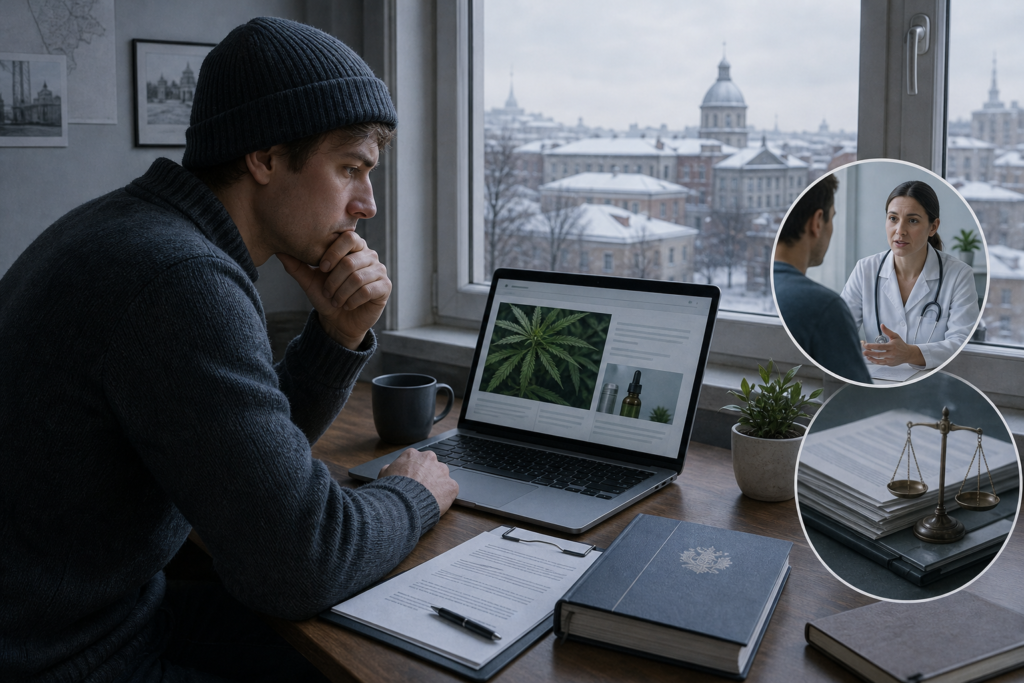
People searching for medical cannabis in Tomsk should speak with a licensed doctor about the underlying condition and legal treatment options. A clinician can assess symptoms, review current medicines, and recommend appropriate care. Do not stop prescribed treatment or substitute an unverified product based on advertising.
How to recognize risky cannabis offers
When no lawful retail market exists, claims of “trusted” sellers are particularly difficult to verify. The following signs do not prove criminal conduct on their own, but they are strong reasons to disengage and avoid sending money or personal information:
- Promises of guaranteed delivery, anonymous delivery, or immunity from police checks.
- Requests for cryptocurrency, gift cards, advance transfers, or payment to an unrelated personal account.
- Pressure to move immediately to an encrypted messenger or to delete the conversation.
- Requests for passport details, selfies, bank information, home access codes, or photographs of identification.
- Unverifiable claims about laboratory certificates, medical approval, or a foreign license.
- New accounts with copied photographs, inconsistent addresses, spelling errors, or reviews that appear repetitive.
- Instructions to collect a package from a hidden location or to pass it to another person.
- Threats, blackmail, or additional payment demands after an order has supposedly been placed.
A seller can also be a scammer rather than a cannabis provider. Some accounts take payment and disappear; others collect identity data for fraud. Do not attempt to “test” a suspicious retailer with a small order. The safest response is to stop communicating and preserve relevant messages if you need to report the account.
How to evaluate claims about weed in Tomsk
Search results for weed in Tomsk may include old pages, automated listings, affiliate content, or advertisements designed to look like local businesses. Search visibility is not proof of licensing, product quality, or legality. Before trusting any health or legal claim, check who published it, whether the source is accountable, and whether the information applies to Russia.
A practical verification checklist
- Identify the legal entity behind the offer, including its registered name and physical business details.
- Ask what Russian authority issued the relevant license and verify the information through an official source.
- Check whether the product category is actually permitted for sale and whether the stated ingredients match applicable rules.
- Be skeptical of anonymous testimonials and certificates that cannot be independently confirmed.
- Never provide personal documents or payment details merely to “reserve” a product.
- If the seller refuses to answer basic questions or creates urgency, end the conversation.
In practice, a seller offering recreational cannabis to ordinary consumers will not become trustworthy simply because it provides a catalog, delivery map, or customer-support account. The core problem is the absence of a normal legal retail framework for that transaction.
Health and safety concerns with unregulated products
Unregulated cannabis can present risks beyond the legal consequences of possession or purchase. The contents may differ from the label, and the material may contain pesticides, mold, heavy metals, synthetic cannabinoids, or other substances. Edibles can be especially difficult to assess because effects may be delayed and the dose may be unclear.
Mixing cannabis with alcohol, sedatives, or other psychoactive medicines can increase impairment and other risks. Anyone who experiences severe confusion, chest pain, difficulty breathing, loss of consciousness, extreme agitation, or a suspected poisoning should seek emergency medical help immediately. Do not delay treatment because of embarrassment or fear of judgment.
The World Health Organization’s cannabis health information provides general background on health effects and risks. It is not a substitute for an examination, diagnosis, or individualized medical advice.
What to do if someone offers cannabis online
If you receive an unsolicited offer, do not click unknown payment links, download files, or share your location. Save the username, profile link, messages, payment instructions, and any transaction records. Then block the account and report it to the platform. If money or personal information has already been sent, contact your bank or payment provider quickly and change compromised passwords.
Where there are threats, extortion, suspected distribution near a school or workplace, or a serious risk to someone’s safety, contact the appropriate local emergency or law-enforcement service. Keep your report factual. Do not arrange a meeting, confront the seller, or attempt to collect evidence by making another purchase.
Safer legal alternatives for support
People searching for legal cannabis alternatives in Tomsk may actually be looking for help with pain, insomnia, anxiety, appetite, stress, or another health concern. A licensed doctor or pharmacist can help identify evidence-based options and check for interactions with medicines already being taken. Mental-health concerns can also be discussed with a qualified psychologist or psychiatrist.
For general wellbeing goals, legal options may include sleep-focused care, physiotherapy, non-intoxicating recreational activities, behavioral support, or treatment for an underlying condition. The appropriate choice depends on the person’s symptoms and medical history, so product advertising should not replace professional assessment.
Questions to ask before trusting any seller
If an organization claims to sell a cannabis-related product legally, ask for precise, verifiable information rather than accepting broad assurances. What is the registered business name? What is the exact product category? Which authority regulates it? Can the license be confirmed independently? Does the label clearly state ingredients, warnings, manufacturer details, and expiration information?
If answers are vague, aggressive, or impossible to verify, walk away. A legitimate business should not require secrecy, unusual payment methods, or risky collection instructions. Most importantly, do not interpret a seller’s use of words such as “licensed,” “medical,” “organic,” or “safe” as independent proof.
Conclusion
There is no dependable list of legal recreational cannabis retailers in Tomsk because Russia does not operate a standard licensed cannabis retail market for ordinary consumers. As a result, claims about trustworthy weed retailers in Tomsk should be approached as potential legal, health, and scam risks rather than as normal shopping opportunities.
Use official legal sources, seek medical advice from licensed professionals, and avoid sellers demanding secrecy, advance payment, personal documents, or hidden-location collection. If you have already interacted with a suspicious account, protect your finances and report threats or fraud instead of pursuing the transaction.

The Ziklane Editorial Team is dedicated to providing accurate, well-researched, and up-to-date information on cannabis laws and regulations around the world. Our content is created through careful research of publicly available legal sources, government publications, and reputable references to help readers better understand local cannabis legislation. We are committed to delivering educational, factual, and regularly updated content while encouraging readers to comply with the laws of their respective countries and regions.